
Most back sleepers land somewhere around 3 to 5 inches (7.5–13 cm) of pillow height under the weight of their head, with a firmer, rounded section filling the curve of the neck and a lower, softer section under the skull. But that range is a starting point, not a prescription. The honest way to find your own number is to run three home tests — chin, hand-gap, and side photo — and adjust from there. Your mattress moves the answer, too.
If you sleep on your back, you've probably read that you need a "medium loft" pillow and been none the wiser. Medium compared with what? Measured how? And why does the pillow that felt perfect in the store leave you with a tight neck and a chin pressed toward your chest by morning?
This guide answers those questions the practical way. We'll go through what a back sleeper's neck actually needs, why the standard height range is less scientific than it sounds, how the number on the packaging differs from the height you actually sleep on, and how your mattress quietly changes everything. Then we'll give you the three tests that tell you whether the pillow on your bed right now is too high, too low, or fine.
What does a back sleeper's neck actually need from a pillow?
Lie on your back on a hard floor with no pillow and you'll feel the issue immediately: there's a gap between the back of your neck and the floor. That gap is the natural curve of your cervical spine — the same forward curve you have standing up, viewed from the side. A pillow's job in this position is to fill that gap without lifting your head so far that the curve flattens or reverses.
So a back sleeper's pillow has a different job to do than a side sleeper's. On your side, the pillow has to bridge the full distance from your ear to the point of your shoulder, which is why side sleepers usually need 1 to 2 inches (2.5–5 cm) more height than back sleepers of the same build — we go through that measurement in the side sleeper pillow height guide. On your back, there's no shoulder to clear. The head sits lower, and the pillow's most important feature isn't its overall height but the shape of the part under your neck.
Harvard Health puts it simply: "If you sleep on your back, choose a rounded pillow to support the natural curve of your neck, with a flatter pillow cushioning your head" (Harvard Health Publishing). Two heights in one pillow, in other words: higher under the neck, lower under the skull. That's the geometry a contoured cervical pillow is built around, and it's why a flat rectangular pillow — even at the "right" height — often feels wrong for back sleeping. It fills the neck gap and lifts the head by the same amount, and the head didn't need lifting.
The research backs the priority on shape. A 2021 systematic review and meta-analysis in Clinical Biomechanics that pooled the available pillow studies concluded that cervical alignment "may be significantly impacted by the shape and height of the pillow" (Chun-Yiu et al., 2021, PubMed). Shape and height. Not material, not brand, not thread count. Hold on to that, because the rest of this article is about getting those two things right for your body.
How high should a pillow be for back sleepers?
Here's the number every competing guide gives you: 3 to 5 inches (7.5–13 cm). Some narrow it to 3 to 4. The advice is consistent enough that it looks like settled science.
It isn't, and we'd rather tell you that than pretend otherwise. A 2021 review in the journal Healthcare that looked specifically at how pillow height is determined and evaluated states plainly that "there remain no firm conclusions about the optimal pillow height for the supine and lateral positions" (Lei et al., 2021, PMC). Supine means on your back. The authors identify four things that actually determine the right height for a given person: cervical spine alignment, body dimensions, contact pressure, and muscle activity. Notice what isn't on the list: a universal number of inches. One disclosure for the record, since the paper makes it: two of its authors worked for a pillow manufacturer. That's stated in the article itself, and it doesn't change the conclusion, which is more cautious than anything a pillow brand would want printed.
So why does "3 to 5 inches" get repeated everywhere? Because it's a reasonable average for a reasonable average adult on a reasonable average mattress, and because a fixed number sells a fixed pillow. It's a fine place to start. It's a bad place to stop.
What the four determinants tell you in practice:
- Body dimensions. A broad-shouldered, thick-necked person has a deeper neck curve to fill than a small-framed one. Same position, different height.
- Contact pressure. A pillow that's the right height but too firm concentrates pressure on the back of the skull; too soft and your head sinks until the height isn't the height anymore.
- Muscle activity. If your neck muscles have to work to hold your head in position all night, the pillow isn't supporting you — you're supporting the pillow. That's the tension you feel at 6am.
- Alignment. The goal all three serve: head level, chin neither tucked nor tilted, the curve of the neck supported rather than flattened.
You can't measure contact pressure or muscle activity at home. You can check alignment, which is what the three tests below are for.
Why is the height on the label not the height you sleep on?
This is the single biggest reason back sleepers buy the "right" pillow and still wake up sore, and almost nobody spells it out.
The loft printed on the box or the product page is measured with nothing on the pillow. It's the height of the pillow lying on a flat surface, fluffed, untouched. The moment you put a human head on it — roughly 10 to 11 pounds (4.5–5 kg) of it — the pillow compresses. How much it compresses depends entirely on the fill.
A down or polyester pillow labeled 5 inches (13 cm) can easily be sleeping at 2.5 to 3 inches (6–7.5 cm) an hour into the night, and lower by 4am as the fill keeps settling. A molded memory foam pillow labeled 4 inches (10 cm) compresses far less, because the shape is built into the foam rather than made of loose filling that can move out of the way. Two pillows with the same number on the label can put your head at heights that differ by 2 inches. And 2 inches is the difference between the right pillow and the wrong one.
Practical rule: the label loft is the ceiling, not the promise. For soft, loose fills, assume you'll lose a large share of the labeled height under your head. For molded foam and latex, assume you'll keep most of it. This is why soft "medium loft" pillows so often leave back sleepers with their head tilted back — the pillow was medium in the store and low by midnight. The materials side of this is covered in depth in our memory foam vs down vs latex comparison, but for the back sleeper question, the short version is: the number that matters is compressed height, and only fills that hold their shape give you a number you can rely on.

Does your mattress change the pillow height you need?
Yes, and this is the second thing the standard advice skips. A pillow and a mattress work as one system. The mattress decides how far your shoulders and upper back sink, and that decides how big the gap under your neck is before the pillow even gets involved.
On a soft mattress, your shoulders and the back of your ribcage sink into the surface. Your head, which is narrower and lighter, sinks less. The result is that the mattress itself has already done part of the pillow's job: the gap between the back of your head and the surface is smaller, so you need less loft. Put a 5-inch pillow on a plush mattress and a back sleeper's chin ends up pointed at their chest.
On a firm mattress, nothing sinks. Your shoulders sit on top, the surface stays flat, and the full curve of your neck is hanging in air. You need more loft to fill it. The same 3-inch pillow that was perfect on a soft bed leaves your head tilted back on a firm one.
Here's the rule of thumb we use, built from the 3 to 5 inch starting range and adjusted for how the surface behaves. These are compressed heights — what's under your head, not what's on the label.
| Mattress feel | What your shoulders do | Compressed loft to aim for (back sleeper) | Common mistake |
|---|---|---|---|
| Soft / plush (deep memory foam top, pillow-top) | Sink noticeably; head sinks less | Low end: about 2.5–3.5 in (6–9 cm) | Buying "medium" and waking up with the chin tucked |
| Medium (most hybrids, most foam beds) | Sink slightly | Middle: about 3–4.5 in (7.5–11 cm) | Trusting the label loft on a soft fill |
| Firm / extra firm (traditional innerspring, firm latex) | Sit on top, almost no sink | High end: about 4–5 in (10–13 cm) | A thin pillow that lets the head tilt back |
One more variable: a new mattress changes the equation. If you replaced your bed recently and your old pillow suddenly feels wrong, the pillow didn't change. The surface under it did.
How do you tell if your pillow is too high or too low? The three tests
Every back sleeper guide mentions the "chin test" and then explains it in one sentence. Here is the full protocol, plus two more tests that catch what the chin test misses. Each takes about a minute. Do them on your own mattress, with the pillow you actually use, at the time of night you'd actually be lying there — not standing in a store.
Test 1: The chin test
Lie on your back, settle in for thirty seconds, and relax your neck completely. Now pay attention to where your chin points.
- Pass: your chin is roughly level with your breastbone. If you drew a line from your chin straight down, it would land somewhere on your sternum, and your face is pointing at the ceiling, not past it or short of it.
- Too high: your chin is pushed toward your chest. Your face points at the wall past the foot of the bed. You can feel a slight stretch or crowding at the back of the neck, and swallowing feels a little tighter than it does standing.
- Too low: your chin tilts up and back. Your face points at the wall behind the headboard. The front of your throat feels stretched and the hollow of your neck is empty — the pillow is holding your skull, not your neck.
The catch with this test: it's a feeling, and after months on the wrong pillow, the wrong position feels normal. That's why the next two exist.
Test 2: The hand-gap test
Still on your back, slide your flat hand, palm down, into the space between the back of your neck and the pillow. Don't lift your head to make room.
- Too low: your hand slides in easily with air to spare. The pillow isn't reaching the curve of your neck, and your neck muscles are holding that gap open all night.
- Pass: your hand goes in with light, even contact on both sides — the pillow is touching your neck along its curve but not pushing it.
- Too high (or wrong shape): you can't get your hand in at all, because the pillow is packed hard against the neck and shoving the head forward. If the chin test also said "too high," you have your answer.
The hand-gap test is the best way to spot a flat pillow that's the right overall height but the wrong shape: the head is fine, the neck is unsupported. That combination is extremely common with rectangular pillows and is exactly the problem a contoured pillow's raised neck roll is designed to solve.
Test 3: The photo test
This is the one no one does, and it's the most reliable of the three, because you cannot judge your own head position from the inside. Have someone stand beside the bed and hold their phone at mattress level — not from above, not from a standing height, but level with the surface you're lying on — and take a photo of you lying naturally on your back, eyes closed, in your usual position.
Then look at the picture the way a physical therapist would:
- The line from your forehead to your chin should be roughly parallel to the mattress. If your forehead is higher than your chin, the pillow is too low. If your chin is higher than your forehead, it's too high.
- Your ear should sit roughly over the midpoint of your shoulder, not in front of it.
- The curve of your neck should be filled, with no visible daylight between neck and pillow.
Save the photo. When you try a new pillow, take the same shot and compare. It's the only objective record you'll have, and it settles the "I think it feels okay" argument that keeps people on the wrong pillow for years.

Should back sleepers choose a firm or soft pillow?
Medium to medium-firm, for a reason that follows from everything above: the height only counts if the pillow keeps it. A very soft pillow can be the perfect loft at 11pm and the wrong loft by 2am, and a back sleeper's head has nowhere to go but back when the fill gives way.
Firmness and shape also interact. Under the skull, you want a little give — enough that the back of the head isn't resting on a hard point, which is the contact-pressure problem the Healthcare review flagged. Under the neck, you want firmness, because that's the part doing the structural work. A single-firmness rectangular pillow forces a compromise: soft enough for the head means too soft for the neck, and vice versa. A contoured pillow gets around this by shape rather than by softness — the raised roll under the neck is doing the holding, and the dished center lets the head sit a little lower with less pressure.
The failure mode to watch for with "firm": a pillow that doesn't give at all under the skull will feel great in the store and leave a tender spot on the back of your head after a week. Firm under the neck, some give under the head. That's the target.
Can a back sleeper use a contour (cervical) pillow?
Back sleepers are the position contour pillows were designed for. The classic shape — a raised roll along one edge with a shallower dip in the middle — is a physical version of the Harvard advice: rounded support under the curve of the neck, flatter cushioning under the head.
What matters is getting the height of the roll right, and this is where a contour pillow with adjustable height earns its place over a fixed one. The Derila Ergo, the memory foam pillow we cover on this site, is a good example of the type: a molded contour with a neck roll for cervical support, and a design that lets you change the height so you can work down from "too high" using the three tests rather than guessing once and living with it. A molded foam core also means the compressed height is close to the labeled height, which solves the label-versus-real problem from earlier. Our full Derila Ergo review covers how the adjustment works and who it suits.
Two things to expect with any contour pillow, so they don't surprise you:
- An adjustment period. If you've spent years on a flat pillow, a neck roll feels odd for the first nights, even when the tests say the height is right. Give it about two weeks before judging. This is where a long return window matters — in Derila's case, a 60-night guarantee counted from the day the parcel is delivered, which is enough time to run the tests, try the different heights, and settle in.
- Shape needs to match position. A contour pillow's roll works because you keep your neck on it. If you sleep on your back but wake up sideways, you want a contour with raised side wings for the side-sleeping hours as well as the center dip for the back-sleeping ones.
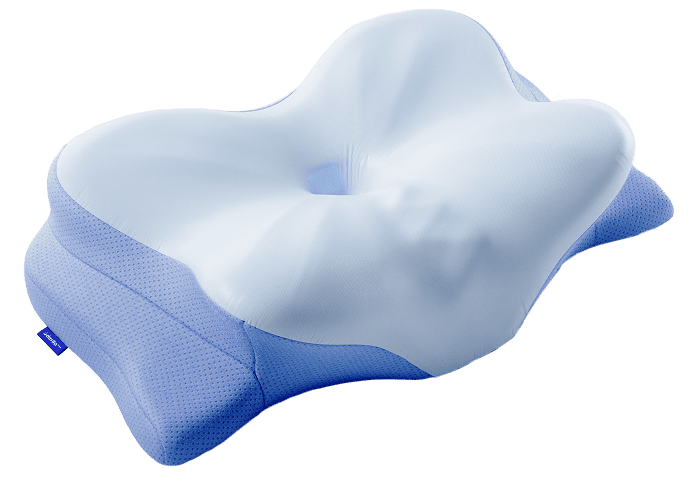
Derila Ergo contoured pillow
A molded memory foam contour pillow with a neck roll for back sleeping, raised wings for side sleeping, and adjustable height so you can dial in the loft with the chin and photo tests. Our full review covers who it suits and how to set the height on night one.
- 60-night money-back guarantee from delivery
- Up to 70% off currently
- 3 free bonuses included
- OEKO-TEX certified cover
Should back sleepers use one pillow or two?
One. Stacking two pillows is the most common way back sleepers end up too high, because two standard pillows are 6 to 10 inches (15–25 cm) on the label and still 4 to 6 inches (10–15 cm) compressed — well above the starting range for almost everyone. The chin goes to the chest, the back of the neck rounds, and the morning tightness across the shoulders follows.
People usually stack for one of two reasons, and both have a better fix:
- The single pillow is too flat. Then the pillow has died or was always too low. Replace it with one pillow at the right compressed height rather than two at the wrong one. The fold test tells you in ten seconds whether a down or polyester pillow is done — it doesn't work on memory foam, which is built to come back slowly on purpose.
- Reflux, congestion or a doctor's advice to sleep elevated. Then the goal is to raise the whole upper body, not just the head. Two pillows under the head bend the neck; a wedge or a raised bed frame lifts the torso as a unit. Different problem, different tool.
A second pillow under the knees, on the other hand, is a genuinely good idea for back sleepers with a tight lower back. It takes the strain off the lumbar curve without touching your neck alignment at all.
What if you sleep on your back and snore?
Back sleeping and snoring travel together, because gravity pulls the tongue and soft palate backward into the airway when you're lying face-up. Pillow height sits right in the middle of this, and it cuts both ways.
Too high pushes the chin toward the chest, which folds the throat and narrows the airway further — the same posture you'd never hold on purpose while trying to breathe deeply. Too low lets the head tilt back and the jaw drop open, which can also worsen snoring for some people. The sweet spot for breathing is the same sweet spot for the neck: chin level, airway open, head neither crunched forward nor thrown back. That's a real reason to get this right beyond a sore neck, and one more argument for the photo test — a folded throat is easy to see in a side-on picture.
If snoring is your main concern, the honest picture is that a pillow helps when the snoring is position-related, and something else is needed when it isn't — so it pays to know which one you have. We go through that in detail in Can a pillow stop snoring? — including when snoring is a reason to talk to a doctor instead of a reason to shop.
A back sleeper's pillow checklist
If you take one section away, take this one:
- Start from compressed height, not label height. Around 3 to 5 inches (7.5–13 cm) under your head is the usual range; soft fills lose much of their label loft, molded foam and latex keep most of it.
- Adjust for your mattress. Soft bed, go lower. Firm bed, go higher. New bed, re-test.
- Prioritize shape over height. Firm, rounded support under the neck; lower and softer under the head. That's what the research says matters, and what the Harvard advice describes.
- Run all three tests on your own bed: chin level with the breastbone, hand slides in with light contact, side photo shows forehead-to-chin parallel to the mattress.
- One pillow under the head, never two. A second one goes under the knees if your lower back wants it.
- Prefer adjustable height if you're unsure, and buy from somewhere with a return window long enough to cover the two-week adjustment.
If you test a contour pillow, know the return terms first
Two weeks is the fair trial for a new pillow shape, so the return policy is the spec that matters most. On the Derila support pages, the 60-night guarantee is counted from the day the parcel is delivered, not the day you order. To return it, you email support@derila.com and request an RMA number first — parcels sent back without one aren't processed. Return shipping is at your cost. Once the warehouse receives the pillow, the refund is issued within 14 days and usually lands 3 to 5 business days after that. Terms can change, so read them on the order page before you buy.
The bottom line
"3 to 5 inches" is where the conversation starts, not where it ends. The research is honest that there's no single right height for sleeping on your back; there's a right height for you, set by your build, your mattress, and how much the pillow compresses under a real head. Shape matters at least as much as the number: neck supported, head cushioned lower.
The good news is you don't need a lab to find your answer. Lie down tonight, check your chin, slide a hand under your neck, and get someone to take one side-on photo at mattress level. In about three minutes you'll know whether the pillow you own is too high, too low, or the wrong shape — and you'll know exactly what to look for when you replace it.
Frequently asked questions
What pillow height (loft) is best for back sleepers?
Most back sleepers do well with about 3 to 5 inches (7.5–13 cm) of height under the weight of the head, with firmer support under the neck and a lower, softer area under the skull. Treat that as a starting range, not a rule: a 2021 review in the journal Healthcare found there are no firm conclusions on the optimal pillow height for back sleeping, because it depends on your body dimensions, contact pressure, and muscle activity. Adjust from the starting range using the chin, hand-gap, and photo tests, and go lower on a soft mattress and higher on a firm one.
How do I know if my pillow is too high?
Lie on your back, relax, and notice where your chin points. If it's pushed toward your chest and your face points past the foot of the bed, the pillow is too high. A side-on photo taken at mattress level will show your chin sitting higher than your forehead. Other signs: tightness or crowding at the back of the neck in the morning, tension across the tops of the shoulders, and a habit of pulling the pillow down under your shoulders during the night to get lower.
Should back sleepers use one pillow or two?
One. Two stacked pillows are typically 4 to 6 inches (10–15 cm) even after compressing, which pushes the chin toward the chest and rounds the neck for most back sleepers. If a single pillow feels too flat, replace it with one at the right height rather than doubling up. If you need to sleep elevated for reflux or congestion, use a wedge that raises the whole upper body instead of bending the neck. A second pillow under the knees, not the head, is a good option for back sleepers with lower back tightness.
Is a firm or soft pillow better for sleeping on your back?
Medium to medium-firm. The pillow's height only helps if it's still there at 4am, and a very soft pillow compresses until the head tilts back. The ideal is firm under the neck, where the pillow is doing the structural work, with a little give under the skull so the back of the head isn't resting on a hard point. A contoured pillow achieves that by shape rather than by softness, which is why it tends to suit back sleepers better than a single-firmness rectangular pillow.
Can a back sleeper use a contour (cervical) pillow?
Yes — back sleeping is the position contour pillows were designed for. The raised neck roll and lower center dip match the Harvard Health advice for back sleepers: rounded support under the curve of the neck, flatter cushioning under the head. The key is getting the height of the roll right, so an adjustable contour pillow is safer than a fixed one. Expect about two weeks of adjustment if you're coming from a flat pillow, and use the three tests to confirm the height rather than judging on night one.
Why does a pillow labeled 5 inches feel much lower when I lie on it?
Because the label height is measured with nothing on the pillow. Under the weight of a head, loose fills like down and polyester can lose a large share of their labeled height, and keep settling through the night. Molded memory foam and latex compress far less because the shape is built in. When comparing pillows for back sleeping, the compressed height under your head is the number that matters.
How we researched this article
This guide is a review of the published literature plus manufacturer specifications and publicly available customer feedback. It is not laboratory testing and it is not medical advice. The mattress-firmness table is a practical rule of thumb built from the commonly cited 3 to 5 inch range, not a published standard. Return and refund terms come from the manufacturer's own support pages, checked in September 2026.
Sources cited in the text:
- Pillow height determinants and evaluation — Lei et al., Healthcare (Basel), 2021, PMC
- Pillow shape and height and cervical alignment — Chun-Yiu et al., systematic review and meta-analysis, Clinical Biomechanics, 2021, PubMed
- Pillow advice for back sleepers — Harvard Health Publishing, "Say 'good night' to neck pain"
When the pillow isn't the problem
If you have numbness, tingling, or weakness running into an arm or hand, neck pain after any impact, pain with fever or unexplained weight loss, severe pain no position relieves, or you regularly stop breathing or gasp during sleep, stop shopping and see a healthcare professional. Better Nights is an editorial site, not a medical one. Nothing here is a diagnosis or treatment plan.
Read next
- Pillow height for side sleepers — why your side needs 1 to 2 inches more
- Memory foam vs down vs latex — which fills keep their height under a head
- Can a pillow stop snoring? — what position can and can't fix
- Our full Derila Ergo review — rating, who it suits, and how the height adjustment works