
A pillow that's too high or too low holds your neck out of line all night, and that can produce a tension-type or neck-driven headache by morning. But the pillow is only a suspect when the headache starts at the back of the head or base of the skull, often on one side, and comes with a stiff or sore neck. If you also snore, drink most evenings, sleep badly or feel wound up, the headache is more likely coming from somewhere else; the checklist below sorts that out.
Can a pillow actually cause a headache?
It can. A pillow that's the wrong height for the way you sleep holds your neck bent forward, backward or sideways for hours. The muscles at the back of the neck and the base of the skull spend the night under load instead of at rest, and the ache climbs into the head.
That's the tension-type headache, and the National Library of Medicine's MedlinePlus lists among its causes holding your head and neck in an abnormal position, and describes it as a headache that often starts at the back of the head and spreads forward, with a tight or sore neck. A pillow that pushes your chin toward your chest, or lets your head drop toward the mattress when you're on your side, is a seven-hour version of exactly that.
There's a second, more specific kind — the cervicogenic headache, pain that originates in the neck and is felt in the head. Its signature is the key to this whole question. What a pillow does not do, as far as the evidence we could find shows, is cause migraines. If your headache comes with nausea, light sensitivity or a visual aura, a new pillow is not the place to start.
How often is the pillow actually the culprit?
Less often than the pillow blogs suggest — and this is the part that matters most.
The biggest population study on morning headaches we could find interviewed 18,980 people across five European countries and found that 7.6% — about 1 in 13 — regularly woke up with a headache (Ohayon, Archives of Internal Medicine, 2004). Compared with people who woke headache-free, the morning-headache group was far more likely to have:
- Anxiety together with depression — 28.5% versus 5.5%
- A circadian rhythm disorder (shift work, a body clock out of step) — 20.0% versus 7.5%
- Sleep-related breathing problems — 15.2% versus 7.5%
- Insomnia — 14.4% versus 6.9%
- Musculoskeletal conditions — 14.1% versus 7.1%
- Heavy drinking — 12.6% versus 7.7%
The study didn't ask about pillows at all, and the musculoskeletal line is one item on a long list, nowhere near the top. The neck-specific headache is real but a minority: cervicogenic headache accounts for 0.4% to 4% of headaches according to the StatPearls clinical reference. If you have it, your pillow is a legitimate suspect. It just isn't where the odds point first.
The two-minute checklist: is it your pillow, your breathing, your drink or your stress?
Run through these before you touch your bedding.
- Do you snore, or has anyone said you gasp or stop breathing at night? Do you wake unrefreshed however long you slept? If yes, read the breathing section below first.
- Did you drink last night? A routine two or three glasses counts. Alcohol fragments sleep and dehydrates, and a headache on waking is one of its signatures.
- Are you sleeping badly in general? Insomnia was twice as common in the morning-headache group in the Ohayon data, and no pillow addresses it.
- Is your schedule fighting your body clock? Shifts, a very late bedtime, a screen until you close your eyes.
- Are you wound tight? Persistent worry, low mood, jaw clenching. Anxiety and depression were the single biggest factor, and a clenched jaw all night feels a lot like a neck headache.
- Only now: your neck. Does the headache start at the base of your skull? Is it one-sided? Is your neck stiff when you turn it? Three yeses, and the next section is for you.
If you ticked one of the first five, address that first. If your only tick is the last one, the pillow conversation is a fair one.
How do you tell if the headache is coming from your neck?
The cervicogenic headache has a clinical description you can turn into a home test. StatPearls describes it as a headache that usually starts after neck movement, presents as one-sided pain that starts in the neck, and typically comes with a reduced range of motion. Three questions:
- Where does it start? A neck-driven headache begins low, at the base of the skull, and spreads up and forward, often toward the eye on the same side. A band across the whole forehead, or throbbing behind both eyes, is something else.
- Is it one-sided? The neck version stays on one side and doesn't swap. Both sides, or alternating sides, points away from the neck.
- Is your neck stiff when you turn it? Look over each shoulder. Tip each ear toward each shoulder. If one direction is tight or brings on the head pain, the neck is involved; if it moves freely, it's a poor suspect.
Timing is the extra clue. In the 2010 pillow trial covered below, the authors cite a figure from Jull and colleagues that 58% of people with cervicogenic headache reported their headache on waking (Gordon et al., Journal of Pain Research, 2010). A neck headache that's worst on waking and eases as you move fits the pillow story; one that's the same at 7pm doesn't.
If the headache shows up with a stiff neck, chase the stiffness first — it has several causes of its own, ranked in why you wake up with a stiff neck every morning.

If you snore and wake up with a headache, what should you check first?
Your breathing, not your pillow — this is the one combination where buying bedding first is a mistake.
A 2026 study of 3,227 adults with confirmed obstructive sleep apnea found that 35.2% had a morning headache at least once a week (Karkala et al., Life, 2026), and the headaches tracked with how often people were jolted partly awake, not with conventional severity measures. That's a sleep-clinic sample: it says morning headaches are common among people with apnea, not that a morning headache means apnea. Ohayon's population data said the same thing from the other direction: morning headache is not specific to breathing disorders.
Still, if you snore heavily, wake with a dry mouth and a dull headache, and feel unrefreshed after a full night, that cluster deserves a look before a pillow does. The STOP-BANG questions gauge your risk in a minute; we walk through them in can a pillow stop snoring? A pillow changes your head position; it doesn't address a breathing disorder.
What did the one pillow trial on waking headaches actually find?
Very few studies have put people on different pillows and counted headaches. Gordon, Grimmer-Somers and Trott ran a blinded field trial with side sleepers who had no neck condition under treatment. Each person slept a week on each of five pillows — polyester, regular foam, contoured foam, feather and latex — and recorded every morning whether they woke with neck stiffness, headache, or pain into the shoulder blade or arm (Gordon et al., 2010).
The results: the feather pillow performed worst and the latex pillow performed best, and the authors concluded latex could be recommended over the other types for waking headache and shoulder-blade or arm pain. And here's the line that usually gets left out: the contoured foam pillow performed no better than the regular foam pillow.
We cover a contoured memory foam pillow, so we're not going to spin that: shape on its own did not reduce waking headaches in this trial. What separated the pillows was whether they held a side sleeper's head at a stable height all night — feather, the fill that collapses, lost; latex, the fill that doesn't, won. We read that as a finding about height and fit rather than contour as such; that's our interpretation, not the authors' claim. Which fills hold their loft is covered in memory foam vs down vs latex.
Is a high pillow or a low pillow worse for headaches?
Both, depending on your position.
Too high is the classic back-sleeper problem. Two stacked pillows, or one tall soft one, tilt your chin toward your chest and stretch the muscles from the base of your skull down the neck. Hold that for seven hours and the ache sits exactly where a neck headache starts. The first experiment is a single, lower pillow — with a rolled hand towel under the curve of your neck if it feels too flat, a setup shown in how to sleep with neck pain.
Too low is the side-sleeper problem. On your side, the gap between your ear and the point of your shoulder has to be filled, or your head drops toward the mattress and your neck bends sideways all night, loading one side more than the other — one reason a neck headache tends to be one-sided. Down and worn-out polyester are the usual causes.
The number you need is the distance from the base of your neck to the point of your shoulder, the gap a side sleeper's pillow has to fill under load. The two-minute measurement is in the full neck pain guide; the side sleeper guide turns it into a pillow height.
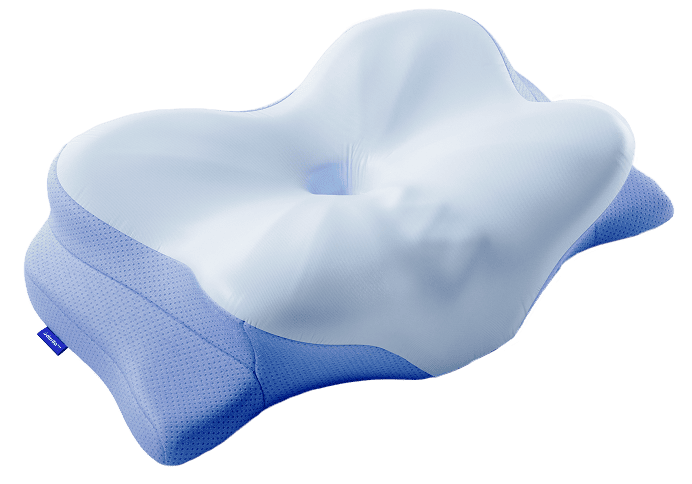
Derila Ergo contoured pillow
A molded memory foam pillow with two contour heights — flip it over to go higher or lower — so a side sleeper's head stays at one height all night instead of sinking. Our full review covers who it fits and how to size it.
- 60-night money-back guarantee from delivery
- Up to 70% off currently
- 3 free bonuses included
- OEKO-TEX certified cover
Did a new pillow start your headaches?
"Headache from new pillow" is a real search with a boring explanation: the new pillow is a different height, and your neck hasn't caught up yet. If you moved from a squashed old pillow to anything that holds its shape, your head now sits higher or lower than it has for years, and the muscles adapted to the old position complain for a while. With a contoured pillow, people commonly need about two weeks before the shape feels normal; the adjustment period is covered in the neck pain guide.
The rule we use across this site: give a new pillow 14 nights, then judge. A headache that's gone by night ten was adjustment. One that's the same or worse on night 14 means the height is wrong for you. With the Derila Ergo, try flipping to the other contour side first, since the two sides sit at different heights; if your shoulders measure more than about 19 inches (48 cm) from the base of your neck to the point of your shoulder, the larger Ergo Plus is built for that gap. Derila's guarantee runs 60 nights from delivery, which covers a 14-night test four times over.

When to see a doctor about a morning headache
A pillow is worth investigating for a mild, neck-driven headache that eases once you're up. MedlinePlus lists the following as reasons to get medical help instead. Call 911 if a headache is sudden and severe (the "worst headache of your life"), comes with trouble speaking, seeing, moving or keeping your balance, or follows a head injury. See a doctor promptly if a headache keeps getting worse over 24 hours, comes with fever, a stiff neck, nausea or vomiting, is your first ever and interferes with your day, is severe and in one eye with redness, or is new and you're over 50.
The bottom line
Can a pillow cause headaches? Yes — when it holds your neck out of line all night. That headache starts low at the back of the head, often on one side, comes with a stiff neck, and the right pillow height is the answer to it.
But 1 in 13 people wake with a headache, and most should be looking at breathing, alcohol, sleep quality, stress or a body clock that's out of step. Run the checklist, then the three-question test. If that's positive, measure your shoulders, pick a pillow that holds that height until morning, and give it 14 nights with a return window long enough to be honest.
Frequently asked questions
Can the wrong pillow give you a headache?
Yes. A pillow that is too high or too low holds your neck bent for hours, and MedlinePlus lists holding the head and neck in an abnormal position among the causes of tension-type headache. The pillow version starts at the back of the head or base of the skull, often on one side, comes with a stiff neck and eases once you are up. If yours doesn't fit that pattern, the pillow is an unlikely cause.
How do I know if my headache is from my neck?
Ask three questions. Does it start at the base of the skull and spread up and forward? Is it on one side only? Is your neck stiff or sore when you look over each shoulder? Three yeses match the clinical description of a cervicogenic headache, pain that originates in the neck. A band across the whole forehead, throbbing behind both eyes, or nausea and light sensitivity point elsewhere.
Can a new pillow cause headaches at first?
It can, and it is usually adjustment. A new pillow that holds its shape puts your head higher or lower than the flattened one you replaced, and contoured pillows commonly take about two weeks to feel normal. Give it 14 nights: a headache that fades by night ten was adjustment; one unchanged on night 14 means the height is wrong for you. On a two-sided contour pillow, flip to the other height before deciding.
Is a high or a low pillow worse for headaches?
Both, in different positions. Too high is the back sleeper's issue: it pushes the chin toward the chest and stretches the muscles from the base of the skull down the neck. Too low is the side sleeper's issue: the head drops toward the mattress and the neck bends sideways, loading one side more than the other. The right height fills the gap between your neck and the point of your shoulder and holds it until morning.
Why do I wake up with a headache but feel fine later?
A headache that is worst on waking and eases as you move has a few common explanations: a neck held in one position all night, alcohol or dehydration, teeth clenching during sleep, or fragmented sleep from snoring or a breathing disorder. With a stiff neck, the pillow is a fair suspect; with snoring or a dry mouth, check your breathing first.
When should a morning headache worry me?
Get emergency help for a headache that is sudden and severe, comes with trouble speaking, seeing, moving or balancing, or follows a head injury. See a doctor promptly if a headache keeps getting worse over 24 hours, comes with fever, a stiff neck, nausea or vomiting, is your first ever and interferes with your day, is severe and in one eye with redness, or is new after age 50. Those are the MedlinePlus warning signs, and none of them is a pillow problem.
How we researched this article
A review of the published literature plus manufacturer specifications. Not laboratory testing, not medical advice. Derila Ergo details checked in September 2026.
Sources cited in the text:
- Ohayon MM, morning headaches in 18,980 people — Archives of Internal Medicine, 2004 (PubMed)
- Gordon SJ et al., five pillows and waking headache — Journal of Pain Research, 2010 (PMC)
- Al Khalili Y et al., cervicogenic headache — StatPearls, NCBI Bookshelf
- Karkala A et al., morning headaches in 3,227 sleep apnea patients — Life, 2026 (PMC)
- Headache causes and warning signs — MedlinePlus (NIH)