
Set the pillow for the position you spend the most time in — for most adults, that's the side — and choose a shape that forgives the other one: a contoured pillow with a raised edge for side sleeping and a lower center for back sleeping covers both jobs without you waking up to fix anything. Then give it 14 nights before you judge it, and buy it somewhere with a return window longer than that.
Here's the trap. You read that side sleepers need a tall pillow, so you buy one. Then you roll onto your back at 4am, your chin gets pushed toward your chest, and you wake up stiff anyway. Go the other way, buy a low pillow for back sleeping, and every hour on your side is an hour with your head tilted toward the mattress.
This isn't another height chart — our side-sleeper and back-sleeper guides each give you a number. This is the article for the space between them: the person who is a side sleeper at 2am and a back sleeper at 5am, and needs one pillow to handle both.
Are you a combination sleeper without knowing it?
A combination sleeper is someone who changes position during the night instead of holding one. Every article on the subject says "you move more than you think," and almost none puts a number on it. There is a number.
In a 2017 study, 664 Danish workers wore small accelerometers at home, in their own beds, and the sensors logged their position through the night (Skarpsno et al., Nature and Science of Sleep, 2017). Averaged across the group, time in bed broke down like this:
- 54.1% on the side
- 37.5% on the back
- 7.3% on the front
And the group changed position 1.6 times per hour in bed, on average. The study reports it per hour; if you do the arithmetic for an eight-hour night, that comes to roughly a dozen shifts — that's our math, not a figure from the paper. Two caveats: the measurement is time in bed, not time asleep, and it's a group average, not a rule for you.
But look at the shape of that result: a little more than half the night on the side, a little more than a third on the back, a dozen or so switches in between. The "pure" side sleeper barely exists. The question isn't whether you're a combination sleeper. It's what your mix is.
How do you find out what your own mix is?
You can't watch yourself sleep, but you can get close enough. Three methods, easiest to most accurate:
- The five-morning log. Before you reach for your phone, note the position you woke up in and the position you fell asleep in. One word each. After five mornings you'll usually see a pattern — "start on side, wake on back" is the most common one we hear about.
- Ask the person next to you. Partners are surprisingly reliable witnesses: they know whether you spend the night facing them, facing away, or flat on your back.
- The phone time-lapse. This is the one that settles it. Prop your phone on a dresser with a view of the bed, plug it in, and start a time-lapse in the camera app. In the morning you'll have a one-minute clip of the whole night. Count the positions and roughly how long you held each.
What you're after is your dominant position — the one you spend the most hours in, not the one you fall asleep in. Falling asleep on your back and spending five hours on your side makes you side-dominant, and that decides which height you build around.

Why does one pillow feel wrong the moment you roll over?
Because the two positions ask for different things. On your side, the pillow has to fill the whole gap between your ear and the point of your shoulder so your head stays level with your spine. On your back, the gap is much smaller: fill the curve of the neck, cradle the skull, don't lift it. Same pillow, two jobs, a few inches apart.
This is why the standard advice for combination sleepers is "buy an adjustable pillow." That's half right. Adjustable-fill pillows let you tune the height once — but you can't take out a handful of fill at 3am when you roll onto your back. For a combination sleeper, adjustability only helps if the shape handles the second position on its own.
Two more things the research is honest about. A 2021 review of pillow-height studies concluded that "there remain no firm conclusions about the optimal pillow height for the supine and lateral positions" (Lei et al., Healthcare, 2021) — so no chart is going to hand you the perfect number for either position, let alone both. And a 2019 scoping review that screened over 4,000 papers found only four that met its criteria, with the tentative finding that "side lying was generally protective against spinal symptoms" (Cary et al., BMJ Open, 2019). The authors say plainly the evidence is thin. We read the two together as: don't fight the fact that you spend half the night on your side. Build the pillow choice around it.
How do you pick one height for two positions?
This is the part the "buy adjustable" articles skip. Here's the rule we use, in three steps.
Step 1: Set the base height from your dominant position
For most people that's the side, which is also the position with the least tolerance for error — an inch too low leaves your head tilted toward the mattress for five hours. You find your side-sleeping number here; it comes from the distance between the base of your neck and the point of your shoulder, and from how far your shoulder sinks into your mattress.
If the time-lapse says you're back-dominant, flip the logic: set the base height for your back, using the chin test, and let the pillow's shape supply the extra height when you turn.
Step 2: Choose a shape that forgives the other position
A flat rectangular pillow has one height everywhere. A contoured pillow doesn't: the raised edge along the front is taller than the dipped center behind it. That difference is the whole trick for a combination sleeper. On your side, your head rests on the raised edge, which is where the extra loft is. When you roll onto your back, your skull settles into the lower center and the raised edge slides under the curve of your neck. The pillow is effectively two heights, and you move between them just by moving.
Once you've set the base height, run the chin test for the back position on the same pillow: lie on your back, relax, and check that your chin points at the ceiling, not at your chest. Passes on the back and level on the side means you've found the height for both.
Step 3: Give it 14 nights, not two
Any new height feels wrong at first, and a contoured shape takes about two weeks before it stops registering as "different." So the verdict comes at night 14, not night 2. Keep the one-word morning log going — position plus "fine" or "stiff" — because that's how you'll see the trend.

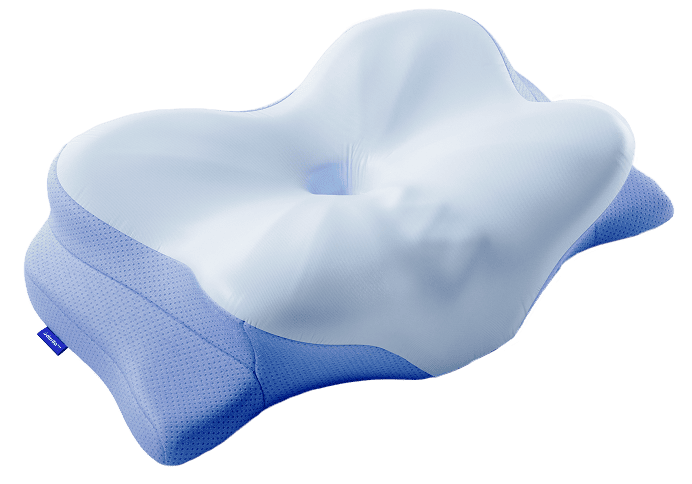
Derila Ergo contoured pillow
A contoured memory foam pillow with two contour sides — one higher, one lower. The height adjustment is flipping it over: sleep on the higher side if your dominant position is on your side, the lower side if you spend more of the night on your back. The raised edge and dipped center then do the two-position work described above. Broad shoulders — more than about 19 inches (48 cm) from the base of the neck to the tip of the shoulder — go to the larger Derila Ergo Plus. Our full review walks through the measurement and which size fits which body.
- 60-night money-back guarantee, counted from delivery
- Two contour heights on one pillow — flip to switch
- Ergo Plus size for broader shoulders
- Removable, OEKO-TEX certified cover (per the manufacturer)
What if you end up on your stomach by morning?
In the Danish study, the front position was only 7.3% of time in bed. That sounds like a rounding error. It isn't, because of when it happens: for many combination sleepers the stomach is the finishing position, the one they drift into in the last hour or two of light sleep. And face-down is the one position where the neck isn't tilted but rotated to one side for as long as you stay there.
The fix isn't a different pillow height. It's giving your body the thing the stomach roll is chasing — contact along the front of the torso — without the rotation. A full-length body pillow hugged with the top arm and top knee does that; you get the same pressed-against-something feeling on your side. We laid out the whole routine, night by night, in the 14-night plan for stopping stomach sleeping. It slots straight into the 14-night pillow test above: same log, same two weeks.
Does your mix change as you get older?
Yes, and this is the finding nobody uses. In the same 2017 study, increasing age and BMI were associated with more time on the side and a proportional reduction in time on the back. The researchers didn't test why, so we won't guess. But the consequence is clear: your mix at 50 is probably more side-heavy than it was at 30, and a heavier body sinks differently into the mattress, which changes the shoulder gap the pillow has to fill. The pillow that was right a decade ago may be the wrong height now — not because it wore out, but because you changed. Re-run the five-morning log after a new mattress, a real change in weight, or a birthday that ends in zero.
The bottom line
You're probably a combination sleeper. The measured average is about half the night on the side, a third on the back, and a dozen or so switches in between — and no one is adjusting a pillow through any of that.
So stop looking for a pillow that's perfect for one position. Set the height for the position you're in most, choose a shape whose raised edge and lower center handle the other one on their own, deal with the stomach-finishing habit separately, and give the whole setup two weeks — bought somewhere the return window is longer than the test. That's the entire method, and it works because it matches how you actually sleep rather than how a height chart assumes you do.
Frequently asked questions
What is a combination sleeper?
A combination sleeper is someone who changes position during the night instead of holding one — typically switching between the side and the back, sometimes finishing on the stomach. By that definition most adults qualify: in a 2017 accelerometer study of 664 people, time in bed averaged 54.1% on the side, 37.5% on the back and 7.3% on the front, with about 1.6 position changes per hour. The useful question isn't whether you switch but which position you spend the most time in.
What pillow height is best if I sleep on my side and back?
Set the height for the position you spend the most hours in, which for most people is the side, and use a contoured shape to cover the other. The raised edge of a contoured pillow gives the extra loft your side needs, and the dipped center gives the lower height your back needs when you roll over. Research hasn't settled on an optimal height for either position, so treat any number as a starting point and test it for 14 nights.
Can a contour pillow work for combination sleepers?
Yes, and it's the shape best suited to them, because a contoured pillow has two heights built in: a raised edge for side sleeping and a lower center for back sleeping. You move between the two heights just by changing position, with nothing to adjust. Some contoured pillows, including the Derila Ergo, also have a higher and a lower contour side, so you can flip the pillow to match your dominant position.
How many times does a person change position at night?
The best measured figure we found is about 1.6 position changes per hour of time in bed, from a 2017 study that tracked 664 adults with accelerometers at home. Over an eight-hour night that works out to roughly a dozen shifts, though that arithmetic is ours, not the study's. The widely quoted "11 to 40 times a night" has no source we could find.
What if I end up on my stomach by morning?
Treat it as a habit to change rather than a height to solve. Hug a full-length body pillow with your top arm and knee so your body gets the front-of-torso contact it's looking for without the neck rotation, and follow a 14-night routine to retrain the position. In the meantime, a contoured pillow's lower center gives your head a less extreme place to land than a tall, flat pillow would.
How we researched this article
This guide is a review of the published literature plus manufacturer specifications. It is not laboratory testing and it is not medical advice. Product details for the Derila Ergo come from the manufacturer's pages and our own review, checked in September 2026.
Sources cited in the text:
- Sleep positions and nocturnal body movements from accelerometer recordings — Skarpsno et al., Nature and Science of Sleep, 2017
- Sleep posture and non-specific spinal symptoms, scoping review — Cary et al., BMJ Open, 2019
- Pillow height determinants and evaluation — Lei et al., Healthcare, 2021
When the pillow isn't the problem
If you have numbness, tingling or weakness running into an arm or hand, neck pain after any impact, pain with fever or unexplained weight loss, or severe pain no position relieves, see a healthcare professional before changing your bedding. Better Nights is an editorial site, not a medical one. Nothing here is a diagnosis or treatment plan.
Read next
- Pillow height for side sleepers — the shoulder measurement, step by step
- Back sleeper pillow guide — the chin test and two more
- How to sleep with neck pain — positions, the rolled towel and the stomach-sleeping plan
- Our full Derila Ergo review — sizes, the shoulder measurement and who it suits