Replace your pillow when it stops holding its height under your head, not when a calendar says so. For most polyester pillows that's around a year; for feather, Harvard says "every year or so"; for memory foam and latex, two to three years is typical. The signs that matter: it fails the fold test (or, for memory foam, the loft and press tests), it's lumpy or permanently flat, it's yellowed, you're doubling it over for height, or you wake up with a sore neck that eases through the morning.
Here's the honest position of this article: nobody knows exactly how often you should replace a pillow, because nobody has studied it properly. What exists is a widely repeated rule of thumb, a widely repeated statistic, and one small real study that almost no one cites. We'll walk you through all three, then give you something more useful than a deadline — tests you can run on the pillow you own tonight, plus the question the guides skip: is it an old pillow, or the wrong pillow?
Where did the "every 1 to 2 years" rule actually come from?
Search this question and you'll get the same answer from a mattress brand, a hotel shop and a sleep portal: one to two years, sometimes stretched to 18 to 36 months. It's stated as fact. So we tried to find the fact underneath it, and couldn't. The document you'd expect to set that kind of rule is the practice parameter on dust mite exposure published by the U.S. allergy societies (AAAAI, ACAAI and their joint council) — the official reference for how to manage bedding if mites are a health concern. It recommends washing bedding weekly to reduce mite numbers and allergen levels, and it recommends mite-allergen-proof encasings for the mattress, box spring and pillow (Joint Task Force practice parameter, Annals of Allergy, Asthma & Immunology, 2013). On throwing pillows away after a set number of years, it says nothing at all. Not one line.
The only medical authority we found putting a number on it is Harvard Health, and it's narrower than the industry version. Harvard's neck pain guidance says feather pillows "will collapse over time, however, and should be replaced every year or so" (Harvard Health Publishing). Feather pillows. The sentence isn't about memory foam or latex, and it isn't a hygiene rule — it's about collapse. The pillow stops holding your head up, so you replace it.
That's the useful idea buried under the folklore. The one-to-two-year rule is a pillow-industry convention, and it's not a crazy one: it roughly matches how long cheap fills last. But it's a proxy. The real rule is the one Harvard is pointing at. Replace a pillow by function, not by calendar. When it can't hold the height your neck needs, it's done, whether that takes eight months or four years.
Is the "30% of your pillow's weight is dust mites" statistic true?
You've read it. "After two years, up to a third of a pillow's weight is dead skin, dust mites and their droppings." It appears on nearly every replacement guide in the top results, usually with no citation. The one brand blog honest enough to credit a source points to a healthcare-industry news site — not a study.
We followed the trail as far as it went, and it ends there. We could not find a single peer-reviewed study that weighed used pillows and reported anything like 30 percent. If one exists, no one repeating the number is citing it. As far as we can tell, it's a marketing figure that got repeated until it sounded like science.
We're telling you this because the real research on old pillows is more interesting than the number everyone repeats — and it does support replacing them, for a reason the 30% line never mentions.
What does the actual research say about old pillows?
A small 2006 study from the UK, published in the journal Allergy, took ten pillows in regular household use, aged from 1.5 to more than 20 years, and cultured what was living inside them (Woodcock et al., Allergy, 2006). The mold Aspergillus fumigatus was isolated from all ten. In total, 47 other fungal species were found across the set, with between 4 and 16 species per pillow — and the synthetic pillows carried more species than the feather ones.
Read the caveats before you throw your pillow across the room. Ten pillows is a very small sample. It's one study, now twenty years old, from one country. It found fungi were present; it didn't measure whether the people sleeping on those pillows got sick. For most healthy adults, a pillow full of ordinary household molds is unpleasant, not dangerous.
But notice what it is: an actual peer-reviewed study that says used pillows accumulate a lot of biology over the years. That's the honest case for replacing pillows on hygiene grounds — a smaller claim than "30% of the weight," and a true one. If you have asthma, allergies or a weakened immune system, it's also a good reason to take the allergists' advice seriously: encase the pillow, wash the bedding weekly, and don't keep a pillow for a decade.
A note on that weekly wash, because a lot of guides get this one wrong. You'll see "wash at 130°F to kill mites" everywhere. The practice parameter actually says home hot water should be kept below the temperature that causes scalding, 120°F (49°C). Wash your bedding hot every week — just don't crank the water heater past a safe setting because a blog told you to.

What are the six signs your pillow is done?
Forget the date you bought it. These are the things a pillow does when it can no longer support your head, in rough order of how often people miss them.
- You wake up with a sore neck that eases through the morning. This is the most important sign and the one people blame on everything else. Pain that's worst on waking and fades by lunchtime is pain that's being created during the night — and a pillow that can no longer hold your neck in line is the first suspect. We ranked the other causes in why you wake up with a stiff neck every morning; check the pillow before the rest.
- You fold it, bunch it or double it over to get height. If you've started sleeping on a folded pillow, you've already replaced it — with a lumpy one. The loft you need isn't there anymore, and you're rebuilding it every night by hand.
- It's lumpy, or it's permanently flat. Fiber and down fills clump and migrate; foam crushes and stays crushed. Either way the surface under your head is no longer even, and an uneven pillow tilts your neck toward whichever side the low spot is on.
- It fails the fold test — if it's the right kind of pillow. Fold it in half, let go. A fiber or down pillow with life in it springs back open; one that stays folded has lost its resilience. There's a big catch for memory foam, which we cover in the next section.
- It's yellowed, stained or smells. The yellow is sweat, oils and skin that have soaked through the case over years. A smell that survives airing means the fill itself is holding moisture and whatever grows in it. Together with the study above, that's a pillow that has done its time.
- Your allergies are worse in bed than anywhere else. If you're congested at night and fine by mid-morning, the thing you're breathing for eight hours is a legitimate suspect. An encasing and a fresh pillow are the two fixes.
Two or more of these together and you don't need a calendar.
Does the fold test work on a memory foam pillow?
No, and this is the mistake almost every replacement guide makes. The fold test checks whether a pillow springs back quickly. Memory foam is engineered not to spring back quickly — it recovers slowly, on purpose, because slow recovery is what lets it mold to your head. Fold a perfectly good memory foam pillow and it will open lazily over several seconds. Judge it by the fold test and you'll throw out a pillow that has years left in it.
Use these two instead. They test what actually fails in foam.
The loft test. Foam doesn't get lumpy; it gets shorter. Over time the cells break down and the pillow loses height it can't recover. So measure it: lay the pillow flat, unloaded, and measure the height at the highest point. Do this when it's new and write the number on the care tag (if you didn't, the manufacturer's listed height is a fair stand-in). When the pillow has lost roughly 20 percent of that height — a 5-inch (12.7 cm) pillow sitting at 4 inches (10 cm) — it's no longer the loft you bought, and if that loft was measured to your shoulders, it's no longer the right loft for you.
The press test. Press your palm firmly into the center of the pillow for a few seconds and take it away. Healthy memory foam refills the dent within a minute. If the impression of your hand — or of your head, in the morning — is still visible after five minutes with no weight on it, the foam's recovery has failed and it won't support you at 4 a.m. either.
The same logic applies to latex, which is springy rather than slow: it's done when it has lost height, cracked or crumbled at the edges, not when it fails a fold test (it generally won't).
How long does each pillow material last?
The ranges below are the ones most retailers and sleep guides converge on. Treat them as a starting point for when to start running the tests above, not as expiry dates. If you want the full story on how each fill behaves under a real head, it's in our memory foam vs down vs latex comparison.
| Material | Typical lifespan | How it dies | Right test |
|---|---|---|---|
| Polyester / fiberfill | 6 months to 2 years, usually closer to 1 | Fibers clump and flatten; the pillow goes lumpy, then thin | Fold test |
| Down / feather | "Every year or so" for feather, per Harvard; the shell can last far longer than the loft | Loses its spring and stops holding height; quills work through the cover | Fold test, plus how often you're re-fluffing |
| Memory foam (molded or contoured) | 2 to 3 years | Loses height and stops recovering from pressure; doesn't get lumpy | Loft test and press test — not the fold test |
| Shredded memory foam | 2 to 3 years | Pieces flatten and shift; the pillow needs more reshaping over time | Loft test; feel for compacted clumps |
| Latex | 3 to 4 years, often longer | Loses height slowly; may crumble or crack at the edges late in life | Loft test; visual check for crumbling |
One thing runs through the table: the fills that last longest are the fills that hold their height. That's not a coincidence. Holding height under a head, all night, for years, is the whole job.
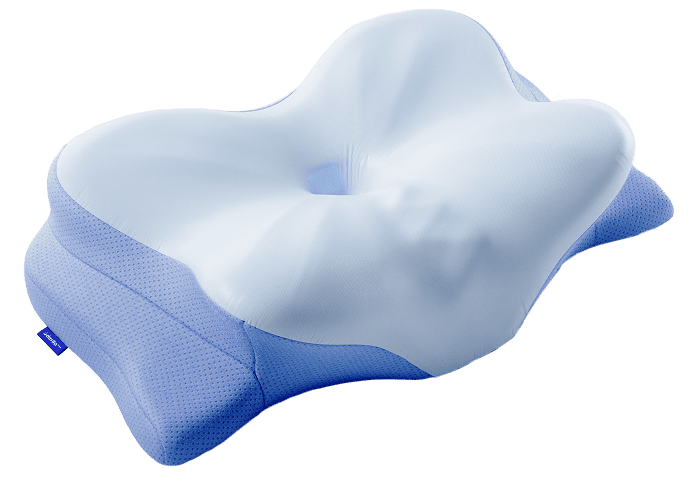
Derila Ergo contoured pillow
A molded memory foam pillow with a dipped center for the head and a raised edge under the neck, sold as a cervical pillow with adjustable height. Because the shape is molded rather than stuffed, it holds its loft rather than clumping — and the loft and press tests above are the right way to check it over time. Our full review covers who it suits.
- 60-night money-back guarantee, counted from delivery
- Up to 70% off currently
- 3 free bonuses included
- OEKO-TEX certified cover
Is your pillow old, or just wrong for you?
Here's the question no replacement guide asks, and it's the one that decides whether buying a new pillow will fix anything.
Two completely different situations both end with "I wake up sore." In the first, the pillow was right and has worn out: it held your neck in line for a couple of years and now it doesn't. Replace it with the same kind. In the second, the pillow is fine and was never right for your body. It's eight months old, it passes every test in this article, and you've been waking up sore for six of those months. An identical pillow buys you another eight months of the same problem.
How to tell them apart:
- When did the pain start? If it crept in after a year or two of good mornings, suspect wear. If it started within weeks of the pillow — or was there before it — suspect the pillow type.
- Does the pillow pass the tests? A pillow that holds its height, refills after pressure and isn't lumpy is not worn out. If you're still sore on it, the problem is loft or shape, not age.
- Does the height match your position? Side sleepers need enough loft to fill the gap between ear and shoulder; back sleepers need less, with support under the neck's curve; stomach sleepers need almost none. A brand-new pillow at the wrong height is a wrong pillow, however fresh. Our neck pain guide walks through the two-minute shoulder measurement.
If your pillow is in the second group, the useful move is to change type rather than age — typically toward a contoured cervical pillow in a material that holds height, like molded memory foam or latex. And because any new pillow shape takes about two weeks to feel normal, this is where the return window matters more than the price. A guarantee counted from delivery, like the 60 nights on the Derila Ergo, is long enough to actually find out whether the new type solves the mornings the old one couldn't.

Can you wash a memory foam pillow?
Not in a machine, and this is the second mistake the replacement guides make. Half of them tell you to "wash your pillow regularly to extend its life" without saying which pillows they mean. A solid or shredded memory foam pillow that goes through a washer comes out as wet, torn foam — the agitation and spin cycle break the cell structure, and a soaked block of foam can take days to dry, which is exactly the moist environment you were trying to avoid. Latex is the same story: no machine, no dryer.
What you can wash: the removable cover, which is the part that actually collects sweat and skin. Wash it with the bedding, weekly. For the foam itself, spot-clean stains with mild detergent on a damp cloth, let it air dry completely out of direct sun, and vacuum the surface gently now and then. Polyester and most down pillows generally can be machine washed (check the tag) on a gentle cycle with a thorough dry — a damp down pillow molds fast.
How do you make a pillow last longer?
None of this changes the physics — a fill that collapses will collapse — but three habits push every pillow toward the long end of its range.
- Use an encasing, not just a pillowcase. A zippered, allergen-proof encasing is the one thing the allergists' practice parameter specifically recommends for pillows. It keeps sweat, skin and mites out of the fill, where they're impossible to remove.
- Wash the layers weekly. Pillowcase and encasing go in with the sheets. A pillow under clean layers ages far more gracefully than a bare one.
- Let it breathe. Pull the covers back in the morning so the pillow airs and dries. Moisture is what the 2006 study's fungi were living on.
Then run the tests once a season. It takes thirty seconds, and it replaces the calendar with something real.
The bottom line
The one-to-two-year rule isn't wrong so much as unsourced: it's the pillow industry's rule of thumb, not a medical guideline. The 30% dust-mite statistic, as far as we can find, has no scientific source. What the real research shows is quieter and more useful — old pillows collect a lot of biology, and worn-out pillows stop holding your neck where it needs to be.
So replace by function. Run the fold test on fiber and down, and the loft and press tests on memory foam and latex, because the fold test lies about foam. Watch for the six signs, especially the morning neck pain that fades by noon. And if a pillow that passes every test still leaves you sore, don't replace it with the same one: it isn't old, it's wrong, and that calls for a different pillow, tested inside a return window long enough to know.
Frequently asked questions
How often should you replace your pillow?
Replace it when it stops holding its height under your head, not on a fixed schedule. The widely quoted "every 1 to 2 years" is a pillow-industry rule of thumb, not a medical guideline; the official U.S. allergists' practice parameter on dust mites recommends weekly washing and allergen-proof encasings but sets no replacement interval. As a starting point, polyester pillows usually last about a year, Harvard suggests feather pillows be replaced every year or so, and memory foam and latex typically last two to three years or more. Run the fold test (fiber and down) or the loft and press tests (foam) to know for sure.
What happens if you never replace your pillow?
Two things. First, the fill collapses or clumps until it no longer holds your neck in line, which is the usual route to waking up sore. Second, it accumulates biology: a small 2006 study of 10 used pillows aged 1.5 to more than 20 years found the mold Aspergillus fumigatus in all ten and between 4 and 16 fungal species per pillow. For healthy adults that's unpleasant rather than dangerous, but for people with asthma, allergies or a weakened immune system it's a real reason not to keep a pillow for a decade. The popular claim that 30% of an old pillow's weight is dust mites has no scientific source we could find.
How do I know if my pillow is causing my neck pain?
The pattern to look for is neck pain that's worst when you wake up and eases through the morning: that's pain being created during the night, and the pillow is the first suspect. Then check the pillow itself. If it's lumpy, flat, fails the fold test, or (for memory foam) has lost about 20% of its original height or holds a dent for five minutes, it's worn out and should be replaced with the same type. If it passes every test and you're still sore, the pillow isn't old, it's the wrong height or shape for your sleep position, and you need a different type rather than a newer copy.
Can you wash a memory foam pillow?
Not in a washing machine. The agitation and spin cycle tear the foam's cell structure, and a soaked block of foam can take days to dry, which invites mold. The same goes for latex. Wash the removable cover weekly with your bedding, spot-clean the foam with mild detergent on a damp cloth, let it air dry completely out of direct sun, and vacuum the surface gently now and then. Polyester and most down pillows can usually be machine washed on a gentle cycle if the care tag allows it, as long as they're dried thoroughly.
How long does a memory foam pillow last compared to down or latex?
Memory foam typically lasts two to three years, latex three to four years or longer, and down or feather considerably less in terms of useful loft: Harvard Health says feather pillows collapse over time and should be replaced every year or so, even though the shell can last much longer. Polyester is the shortest-lived at around a year. The fills that last longest are the ones that hold their height under load. Note that memory foam fails by losing height and recovery, not by going lumpy, so judge it with the loft and press tests rather than the fold test.
How we researched this article
This guide is a review of the published literature plus manufacturer specifications and publicly available customer feedback. It is not laboratory testing and it is not medical advice. Lifespan ranges by material are the ranges most retailers and sleep guides converge on, not the result of testing. Return and refund terms come from the manufacturer's own support pages, checked in September 2026.
Sources cited in the text:
- Fungal contamination of bedding (10 used pillows) — Woodcock et al., Allergy, 2006, PubMed
- Environmental assessment and exposure control of dust mites, practice parameter — AAAAI / ACAAI / JCAAI Joint Task Force, Annals of Allergy, Asthma & Immunology, 2013, PMC
- Feather pillows and replacement — Harvard Health Publishing, "Say 'good night' to neck pain"
When the pillow isn't the problem
If you have numbness, tingling or weakness running into an arm or hand, neck pain after any impact, pain with fever or unexplained weight loss, or severe pain no position relieves, stop shopping and see a healthcare professional. Better Nights is an editorial site, not a medical one. Nothing here is a diagnosis or treatment plan.
Read next
- Memory foam vs down vs latex — how each fill behaves under a real head
- Why you wake up with a stiff neck every morning — seven causes, ranked
- Cervical pillow for neck pain: the complete guide — the height formula, in detail
- Our full Derila Ergo review — rating, who it suits, and what to check before you buy