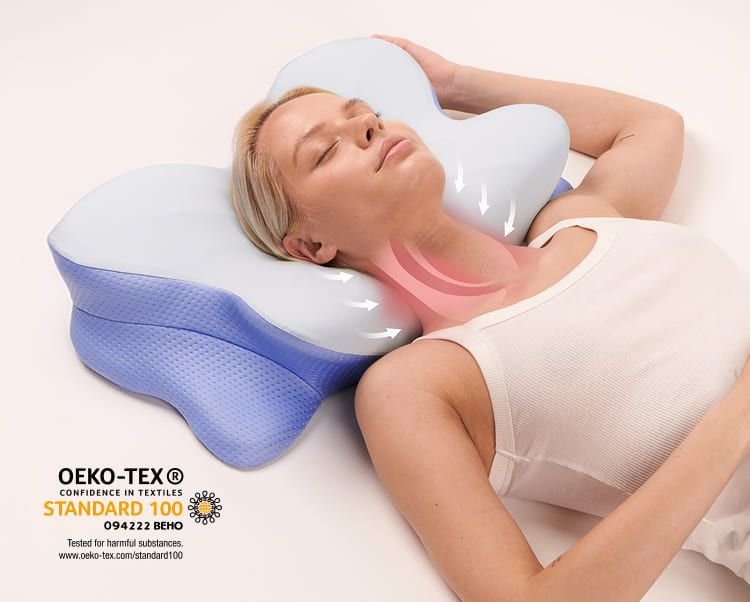
A cervical pillow eases neck pain by filling the gap under your neck so your head stops tipping out of line with your spine. It helps most when pain is worst on waking and eases during the day. Height matters more than brand: measure your shoulder width first. Expect about two weeks of adjustment.
Waking up sore is such a normal experience that most people stop questioning it. You roll out of bed, roll your shoulders a few times, and get on with the day.
Neck pain is not a small problem, though. The Global Burden of Disease analysis published in The Lancet Rheumatology estimated that neck pain affected 203 million people worldwide in 2020, and forecast the number to keep climbing to 2050 (GBD 2021 Neck Pain Collaborators, 2024).
A pillow will not fix all of that. But if your neck feels worst in the first hour of the day and loosens up by lunchtime, the seven hours you spent lying down deserve a serious look.
What is a cervical pillow, and how is it different?
A regular pillow is a bag of filling. It supports whatever presses into it, which means it supports your head — the heaviest part — and lets your neck hang in the empty space behind it.
A cervical pillow is molded. It has a lower, dipped center where your head sits and a raised edge that fills in under your neck. The shape is fixed, so it holds that support all night instead of flattening out by 2am.
The word "cervical" just refers to the cervical spine — the seven vertebrae in your neck. These pillows are also sold as contour, orthopedic, or ergonomic pillows. The names are marketing. The shape is what matters.
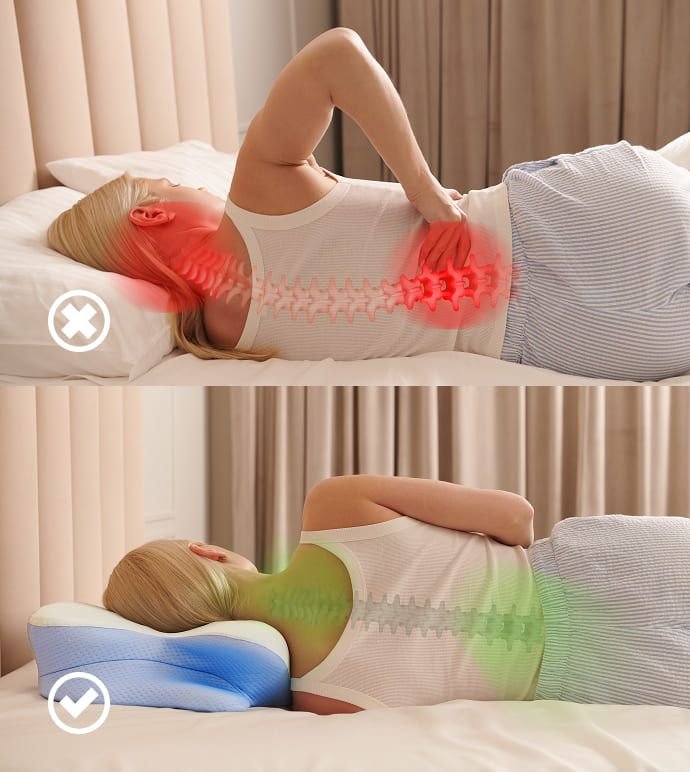
Why does your neck hurt when you wake up?
Four things go wrong at night, and they compound each other.
- Your head tips out of line. On a flat or dead pillow, your head drops below the line of your spine. Muscles that should be switched off spend hours holding tension instead.
- Your pillow is the wrong height. Too high and your chin is pushed toward your chest. Too low and your head falls back. Both end at the same place in the morning.
- You move all night. Nobody holds one position for seven hours. Most pillows support one position well and the other two badly.
- Your pillow is simply old. The common recommendation, including in the Sleep Foundation's guide to replacing pillows, is every one to two years for most types. Foam compresses and filling migrates. A pillow that has gone flat is a pillow that has stopped doing its job.
Notice that three of the four are about height and support, not softness. Softness is a comfort preference. Height is a structural one.
Does a cervical pillow actually help neck pain?
It depends on where your pain comes from — and this is where honest writing matters more than a sales pitch.
A cervical pillow addresses one specific cause: poor positioning of the head and neck during sleep. If that is your problem, correcting it can make a real difference, and fairly quickly.
If your neck pain comes from a disc problem, arthritis, an old injury, long hours hunched over a laptop, or high daily stress, a pillow is not treating the cause. It might make your nights more comfortable. It will not resolve the underlying issue.
A simple test you can run tonight
Pay attention to when your neck hurts. Pain that is worst on waking and fades within an hour or two points strongly at your sleep setup. Pain that builds through the day and peaks in the evening points at your desk, your posture, or something a doctor should look at.
What does the research actually say?
Two things, and they sit awkwardly together. We are going to give you both.
The first: the overall evidence for pillows treating neck pain is weak. A systematic review held in the National Library of Medicine's bookshelf collection looked at the trials on pillows and neck pain and concluded that the studies are small, short, and inconsistent in what they measure — not that pillows fail, but that the research is not strong enough to make confident claims from (review, NCBI Bookshelf). Any article that tells you a pillow is clinically proven to fix your neck is going further than the literature does.
The second: the individual studies that do exist are encouraging, and the mechanism is not mysterious. In a Japanese trial published in the Journal of Physical Therapy Science, patients with chronic neck pain had their pillow height adjusted individually within a 55–85 mm range and were followed for three months. Average pain scores fell from 6.8 to 4.1 on a 10-point scale, and about half the group improved by three points or more (Yamada et al., 2023). Note what was adjusted: not the brand, not the filling. The height.
So why is it still worth testing?
Three reasons. The mechanism is physical and visible — you can photograph your own neck and see whether it is straight or bent. The test is short: two weeks tells you, unlike most health interventions. And the downside is bounded by the return window, which is the one spec worth checking before you spend anything. Weak evidence across a population is not the same as no answer for you.
Memory foam or latex? The honest version
A 2021 systematic review and meta-analysis in Clinical Biomechanics looked at how pillow designs affect neck pain, waking symptoms, neck disability, sleep quality and spinal alignment, and latex came out ahead of the alternatives across the pooled studies (Chun-Yiu et al., Clinical Biomechanics, 2021). If you want the single answer the pooled numbers give, that is it — and it is not the material we sell you on.
Here is the context that matters more. The differences between materials in those studies were small next to the difference between a pillow at the right height and a pillow at the wrong one. Material decides how the surface feels and how long it lasts; shape and height decide where your head sits. Contoured memory foam has one specific advantage in this argument: because it is molded rather than filled, it holds its height under the weight of a head all night, which is exactly where soft pillows fail. Latex is springier, cooler and usually costs more.
Pick material on feel and temperature. Pick height on measurement. The full material-by-material breakdown is in memory foam vs down vs latex.
What height should your pillow be?
This is the question almost nobody asks, and it is the one that decides whether a pillow works for you.
The goal is simple: your nose should stay in line with the center of your chest, and your neck should continue the natural curve of your spine. No bend up, no bend down.
How much height that takes depends on how wide your shoulders are and which position you sleep in.
Measure your shoulders. It takes two minutes and a tape measure.
This is the step almost nobody takes, and it is the closest thing to a formula that exists. Research published in 2024 derived optimal pillow height from shoulder width rather than from height, weight or preference, and tested the resulting heights for both alignment and comfort (study, PubMed). Two findings are worth carrying to a shop:
- 9.7 to 11.8 cm (3.8 to 4.6 in) produced the best cervical alignment — the straightest neck.
- 11.8 to 13.8 cm (4.6 to 5.4 in) produced the highest comfort ratings — what people said felt best.
Those two bands do not overlap perfectly, which is a useful thing to know: the height that lines your neck up best is slightly lower than the height most people like. Broader shoulders sit at the top of both ranges, narrower shoulders at the bottom.
Here is how to find your own number.
- Lie on your side on the mattress you actually sleep on, with no pillow, arms relaxed in front of you.
- Have someone measure the vertical gap from the surface of the mattress up to the side of your neck, just below your ear. That gap — the distance your shoulder lifts your head off the bed — is what a pillow has to bridge. A tape measure held upright against the mattress edge is enough.
- Write the number down in centimetres. Most adults land somewhere between 10 and 14 cm. If yours is under 10, you need a lower pillow than the internet will recommend to you; if it is over 14, most standard pillows will leave your head hanging.
- Adjust for your mattress. On a firm mattress your shoulder barely sinks, so you need more pillow height. On a soft one your shoulder drops into the surface and you need less. Measure while lying on the bed and this is already accounted for.
- Compare with the pillow you own. Press down on your current pillow with the weight of your forearm and measure what is left. That is its real height. The height on the box is the height empty.
Then check it with a photograph
Numbers get you close; the picture confirms it. Lie on your side on the new setup and have someone photograph you from behind, camera level with the bed. Your spine should run in one straight line and your nose should point straight ahead, level with the middle of your chest. Head tipped down toward the mattress means too low. Ear pushed up toward your shoulder means too high.
| You sleep | Gap to fill | Height you need | What goes wrong |
|---|---|---|---|
| On your side | Widest — the whole width of your shoulder | Highest (roughly 4–6 in / 10–15 cm) | Too low and your head drops toward the mattress, bending your neck sideways all night |
| On your back | Small — just the hollow of your neck | Medium-low, with support under the neck itself | Too high and your chin is pushed onto your chest, closing your airway |
| On your stomach | Almost none | Lowest, or none at all | Your head is turned 90° for hours — no pillow fully solves this |
Side sleeping is the most common position by a wide margin. A March 2025 survey of US adults run by the National Council on Aging with Pollfish put it at 63% of adults, with 74% of them reporting pain they associate with how they sleep (NCoA, 2025). If that is you, and you have been using a thin, soft pillow, you have been sleeping with your neck bent sideways for years — here is how to find your pillow height as a side sleeper.
Which shape fits the way you sleep?
Good contoured pillows solve the height problem with geometry rather than asking you to pick a single position.
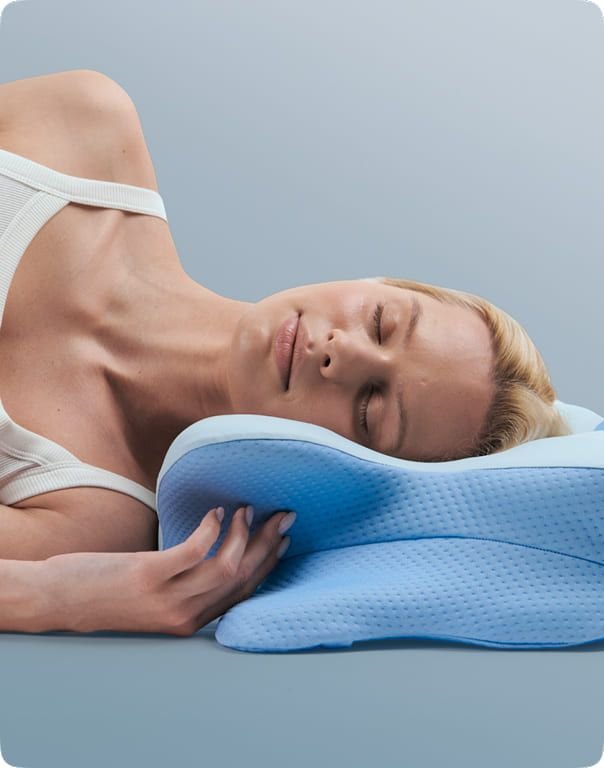
Side sleepers
You need the raised outer edge of the pillow. Your shoulder tucks into the lower cut-out, and the higher wing fills the distance between your ear and your shoulder.
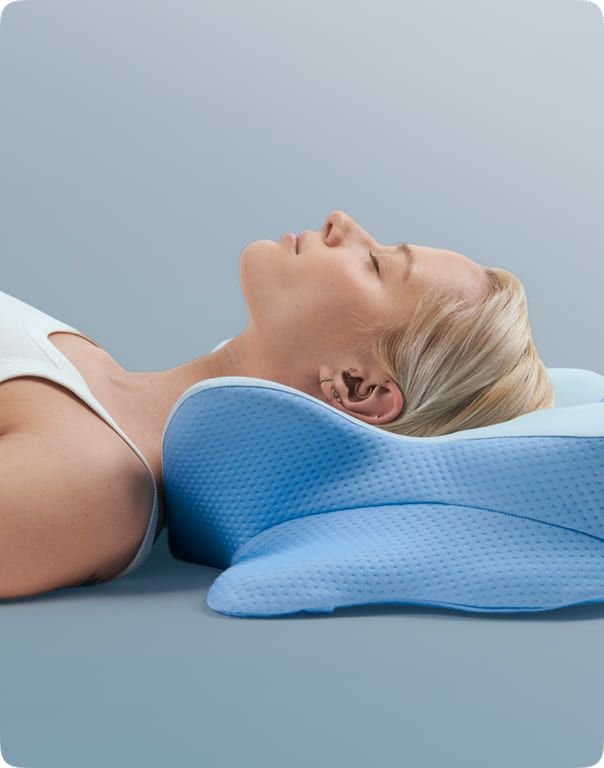
Back sleepers
You need the opposite: a lower center for the back of your skull, with the raised lip supporting the hollow of your neck. That combination keeps your chin neutral rather than tucked.
Stomach sleepers
Be realistic here. Sleeping face-down turns your head sideways for hours, and no pillow undoes that rotation. A very low pillow is better than a tall one. If you wake with neck pain and you sleep on your stomach, changing position will help more than changing pillows.
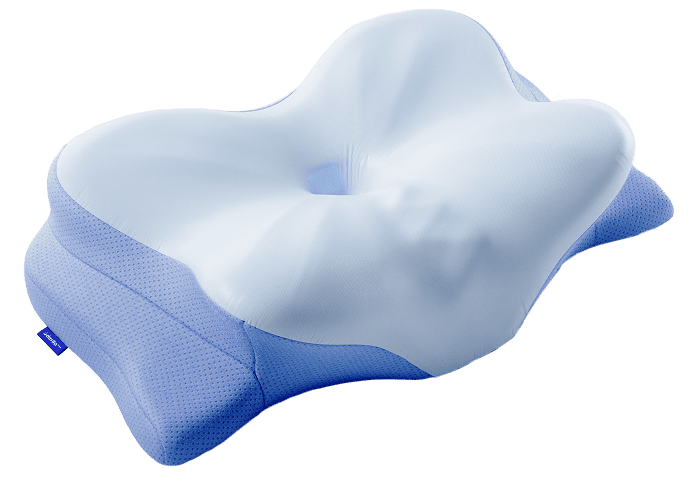
Derila Ergo contoured pillow
A molded memory foam pillow built around exactly the problem above: a low center for your head, raised wings for side sleeping, and a neck lip for back sleeping. It is the option we cover in most detail on this site.
- 60-night money-back guarantee
- Up to 70% off currently
- 3 free bonuses included
- OEKO-TEX certified cover
How long does it take to get used to a cervical pillow?
Give it two weeks. Three if you are stubborn about it.
This is the single biggest reason people return contoured pillows, and it is avoidable. A cervical pillow puts your neck in a position it has not held in years. Correct support can feel wrong at first precisely because it is different. Your muscles have adapted to the old, bad angle.
What is normal in the first week: feeling the shape under your neck, mild stiffness in a new spot, waking once or twice because something feels unfamiliar.
What is not normal: sharp pain, numbness or tingling in your arms or hands, or pain that is clearly worse after two full weeks. That is a sign the height is wrong for you, or that something else is going on.
Why the return window is the spec to check
Any pillow needs about two weeks of adjustment, which means a 14-day return policy is nearly useless — you would have to decide on the exact day the adjustment ends. A 60-night window is long enough to actually know. Check the return terms before you check anything else.
What "60 nights" means in practice. On the Derila support pages, the 60 nights are counted from the day the parcel is delivered, not from the day you order, so shipping time does not eat your trial — that is more generous than it sounds. To return it you email support@derila.com and request an RMA number first; parcels sent back without one are not processed. Return shipping is at your cost. After the warehouse receives the pillow, the refund is issued within 14 days, and the money usually lands 3 to 5 business days later. Terms can change, so read them on the order page before you buy.
"The cervical pillow made my neck worse" — which kind of worse is it?
This is the most common message we get, and it has two completely different answers depending on what the pain is doing. Learn to tell them apart and you will know whether to persist or send it back.
Adjustment pain — keep going
It is diffuse rather than pinpointed. It feels like the ache after a session at the gym, spread across the back or side of the neck and the top of the shoulders. It eases when you change position in bed, and it is gone within an hour of getting up. It gets a little less each week. This is muscle adapting to an angle it has not held in years, and it is normal for roughly the first ten to fourteen nights.
Wrong-height pain — change something
It is specific. The same spot, the same side, at the same time every night. Often it wakes you. It does not ease when you shift position, because the pillow puts you back in the same place. It is the same on night twelve as on night two, or worse. That is not adaptation, that is a pillow that is too tall or too short for your shoulders — go back and measure.
And the third category, which is neither: numbness, tingling or weakness running into your arm or hand, sharp shooting pain, or pain that no position relieves. Stop using the pillow and speak to a healthcare professional. That is a nerve conversation, not a bedding one.
The first-night smell, and whether it matters
Open a new memory foam pillow and you will notice a chemical smell. It is called off-gassing: volatile organic compounds trapped in the foam during manufacturing, released once the packaging comes off. It is unpleasant and it is the reason a fair number of pillows go back in week one.
The practical answer is boring. Unwrap it, stand it somewhere ventilated — a spare room, a hallway, an open window — and leave it 24 to 72 hours before it goes on your bed. In almost every case the smell is gone by then. A day out of the packaging usually does most of the work.
If you want reassurance about what is in the foam, look for a CertiPUR-US mark. It is a foam certification that tests for formaldehyde, phthalates, heavy metals and low VOC emissions. It is not a comfort rating and it says nothing about whether the pillow suits your neck — it is about what you are breathing, and that is a fair thing to want to know before you put your face on something for two years.
When is neck pain not a pillow problem?
We would rather you saw a doctor than bought a pillow, if these apply to you.
See a healthcare professional if you have any of these
- Numbness, tingling or weakness travelling into your arm or hand
- Neck pain after a fall, a crash, or any impact
- Pain with fever, unexplained weight loss, or night sweats
- Severe pain that wakes you and does not settle in any position
- Pain that has not improved at all after several weeks
- You stop breathing during sleep, gasp awake, or snore loudly every night — a 2025 analysis in Respiratory Medicine put obstructive sleep apnea at 83.7 million US adults, 32.4% of the adult population, and largely undiagnosed (Respiratory Medicine, 2025). The Wisconsin Sleep Cohort estimated that 93% of women and 82% of men with moderate to severe apnea had never been clinically diagnosed (Young et al., Sleep, 1997)
Better Nights is an editorial site, not a medical one. Nothing here is a diagnosis or treatment plan.
Who a cervical pillow suits
Worth trying if
- Your neck is worst in the morning and eases during the day
- You sleep on your side or your back
- Your current pillow is flat, folded, or over two years old
- You wake up and rearrange your pillow most nights
- You sleep hot and keep flipping to the cool side
Skip it if
- You already sleep well — there is nothing here to fix
- You want a soft, sink-in pillow; contoured foam is firmer by design
- You sleep on your stomach exclusively
- Your pain has a diagnosed cause — follow that treatment first
- You cannot give it two weeks before judging
Who should not buy a cervical pillow
Most sites in this category will not write this section, which is exactly why it is here. A cervical pillow is a poor purchase if:
- Your pain is worst in the evening. Pain that builds through the day and peaks at night is a desk-and-posture problem. A pillow will not touch it, and you will conclude that pillows do not work when the real answer is that you bought the wrong tool.
- You have a diagnosed cause — a disc problem, arthritis, an old injury. Follow that treatment first. A pillow may make your nights more comfortable, but it is not treating anything.
- You have numbness, tingling or weakness in an arm or hand. See someone about it before you spend money on bedding.
- You sleep on your stomach and intend to keep doing so. The rotation is the problem, and no shape solves rotation.
- You want a soft pillow. Contoured foam is firm on purpose. If you love sinking into a pillow, you will hate this and no adjustment period will change that.
- You cannot commit two weeks. Judged at night three, a correct pillow fails. If you know you will give up early, keep your money.
None of that is modesty. A pillow is a support device with one job, and matching the job to the problem is the whole difference between money well spent and a foam brick in a cupboard.
A five-point checklist before you buy anything
- Match the height to your position. Side sleeper, higher. Back sleeper, lower with neck support. This is the whole game.
- Check the return window. Under 30 nights is not enough time to judge. 60 is comfortable.
- Look for breathability. Solid memory foam traps heat. Ventilated or perforated foam and a mesh cover matter more than they sound — your body needs its core temperature to fall by roughly 1–2°F to fall asleep, and a hot head works against that.
- Check the cover is removable and washable. You will put your face on this every night for two years.
- Ignore the claims about curing things. A pillow is a support device. Any pillow marketed as a cure for a medical condition is overselling.

The bottom line
If you wake up sore and loosen up by mid-morning, your pillow is a reasonable suspect, and a cervical pillow is a low-cost thing to rule in or out. Match the height to your sleep position, give it two full weeks, and buy from somewhere with a long enough return window that you are not gambling.
If your pain does not follow that morning pattern — or if anything in the red-flag list above sounds like you — a pillow is the wrong tool, and a professional is the right one.
Frequently asked questions
How long does it take to get used to a cervical pillow?
About two weeks for most people. The shape holds your neck in a position it is not used to, so the first few nights can feel strange even when the support is correct. Judge it at day 14, not day 2.
Can a cervical pillow make neck pain worse?
Temporarily, yes — mild stiffness in the first week is common as your muscles adapt. If pain is clearly worse after two full weeks, or you feel numbness or tingling in your arms or hands, stop using it and speak to a healthcare professional. The height is probably wrong for you.
What height should a pillow be for a side sleeper?
Higher than most people expect — roughly 4 to 6 inches, enough to fill the whole gap between your ear and your shoulder. Broader shoulders need more. The test is simple: lying on your side, your nose should point straight ahead, level with the middle of your chest.
Are cervical pillows good for back sleepers too?
Yes, and back sleepers often notice the difference fastest. You need a lower center for the back of your skull plus a raised lip filling the hollow of your neck. A pillow that is too tall pushes your chin toward your chest, which can also narrow your airway.
How do I know what pillow height I need?
Measure rather than guess. Lie on your side with no pillow and have someone measure the vertical gap from the mattress to the side of your neck, just below your ear — that is the distance a pillow has to bridge. Research from 2024 that derived pillow height from shoulder width found 9.7–11.8 cm gave the best neck alignment and 11.8–13.8 cm scored highest for comfort. Broader shoulders need the top of the range, and a firm mattress needs more height than a soft one.
Does a cervical pillow smell when you unbox it?
Usually, yes. New memory foam off-gasses trapped compounds from manufacturing, and the smell is strongest in the first hours. Unwrap the pillow and leave it in a ventilated room for 24 to 72 hours before putting it on your bed, and it almost always disappears. A CertiPUR-US mark means the foam has been tested for formaldehyde, phthalates, heavy metals and low VOC emissions.
How often should I replace my pillow?
Every one to two years for most types is the common recommendation, including in the Sleep Foundation's guide to replacing pillows. The practical signs matter more than the calendar: it stays folded when you bend it, you find yourself doubling it over, or you have to punch it into shape before you can sleep.
Will a cervical pillow help my snoring?
Sometimes, if your snoring comes from your head tipping forward and narrowing your airway. It will not help snoring caused by congestion, alcohol, weight, or sleep apnea. We cover this properly in can a pillow stop snoring.
How we researched this article
This guide is a review of the published literature plus a practical measurement guide, alongside manufacturer specifications and publicly available customer feedback. It is not laboratory testing and it is not medical advice. Return and refund terms come from the manufacturer's own support pages, checked in August 2026.
Sources cited in the text:
- Optimal pillow height derived from shoulder width, 2024 — PubMed
- Yamada et al., individually adjusted pillow height and chronic neck pain — Journal of Physical Therapy Science, 2023
- Systematic review of pillows for neck pain — NCBI Bookshelf
- Pillow designs, neck pain and spinal alignment — Chun-Yiu et al., systematic review and meta-analysis, Clinical Biomechanics, 2021
- Sleep position and pain in US adults, March 2025 — National Council on Aging / Pollfish
- Obstructive sleep apnea prevalence in US adults, 2024 — Sönmez I et al., Respiratory Medicine, 2025
- Undiagnosed proportion in men and women — Young T et al., Sleep, 1997 (Wisconsin Sleep Cohort)
- Global neck pain burden, 203 million people in 2020 — GBD 2021 Neck Pain Collaborators, The Lancet Rheumatology, 2024
- Pillow replacement intervals — Sleep Foundation
Read next
- Pillow height for side sleepers with neck pain — the height question, in detail
- Why you wake up with a stiff neck every morning — seven causes, ranked
- Can a pillow stop snoring? — what it can and cannot do
- Our full Derila Ergo review — rating, who it suits, who should skip it