
Sleep on your back with a contoured pillow supporting the curve of your neck, or on the side that doesn't hurt with a pillow tall enough to keep your head level. Never on your stomach. If resting your arm above your head eases the tingling, support the forearm on a second pillow beside your head instead of letting it hang. And the good news first: according to the StatPearls clinical reference (NIH), over 85% of acute cases settle without specific treatment within 8 to 12 weeks.
If you're reading this at 3am with an arm that's burning, buzzing or gone numb, here's the thing nobody tells you before they list sleeping positions: this usually gets better on its own. Your job is to get through the next eight to twelve weeks of nights with as little of that pain as possible — and how you lie down, and what your neck rests on, is the tool for that.
What is actually happening when a nerve is “pinched” in your neck?
The medical name is cervical radiculopathy. At each level of your neck a nerve root exits through a small opening on either side and runs into your shoulder, arm and hand. When something narrows that opening — a bulging disc, a bone spur, swelling — the nerve root gets irritated and complains along its whole route. That's why a problem in your neck shows up as tingling in your fingers or a burning stripe down your arm. According to the StatPearls entry on cervical radiculopathy, a peer-reviewed clinical reference hosted by the NIH's National Library of Medicine and updated in August 2025, the C7 nerve root is involved in more than half of all cases and C6 in roughly a quarter.
Two more facts should change how you feel about this. First, most people can't point to what caused it. In a Mayo Clinic population study from Rochester, Minnesota, which tracked 561 patients between 1976 and 1990, only 14.8% had a physical exertion or injury before symptoms started. If you've spent the week replaying what you did wrong, you can stop. Second, it peaks in midlife: in the same study the rate was highest at ages 50 to 54, more than twice the average across all ages.
One more that catches people out: the pain doesn't always start in the arm. A 2025 scoping review of 86 studies found shoulder-blade pain described in 72% of the studies that mapped where cervical radiculopathy hurts, and noted that scapular pain may precede arm pain by several weeks.
Why is a pinched nerve worse at night?
Standing up, your muscles hold your head centered and you keep moving, so no single position gets held for long. In bed, three things go wrong at once. You stop moving, so whatever angle your neck lands in stays there for an hour or more. Your muscles let go, so the pillow, not your neck, decides that angle. And if the pillow is the wrong height or shape, the angle it picks can be the exact one that narrows the opening the nerve runs through.
There's also nothing to distract you: tingling that was background noise all day becomes the only signal in a dark room. That's real, but it means the same nerve can feel twice as loud at 2am with nothing physically different. The positions below deal with the physical part.
What is the best sleeping position for a pinched nerve in the neck?
On your back: the position that asks the least of the nerve. Lying face-up keeps your head centered — no bend to either side, no rotation. All your neck has to do is keep its natural forward curve, and that's the pillow's job: fill the hollow between skull and shoulders without pushing your head forward. A contoured pillow does this by design; a rolled towel does it for free tonight. Add a pillow under your knees to let your lower back settle.
On your side: workable, if you get two things right. Be on the side that doesn't hurt, and use a pillow that holds your head level. The second condition is where “sleep on your good side” quietly fails — next section.
Semi-reclined: the rescue position for the first hour. Some people find that sitting up at 30 to 45 degrees — a wedge, pillows stacked behind the back, a recliner — takes the edge off enough to fall asleep. If lying flat sets the arm buzzing within minutes, starting reclined and sliding down once you're drowsy is a legitimate strategy.
On your stomach: the one to avoid. Face-down sleeping turns your head 90 degrees to one side for hours with the neck tipped back — the combination that closes the opening around the nerve root. If you're a lifelong stomach sleeper, the body-pillow method in our neck pain sleeping guide is the way off it; for now, a pillow hugged to your chest and one wedged behind your back will stop you rolling over.
Which side should you sleep on — and why does pillow height decide it?
Every guide says “sleep on the side that doesn't hurt.” Almost none say why, and none mention how it backfires.
The why: bending your head toward the affected side narrows the opening the nerve root passes through. That's the principle behind the Spurling test StatPearls describes, in which a clinician presses down on the head while extending and turning the neck toward the painful side to see whether it reproduces the arm symptoms. Lying on the painful side with a low pillow crowds the same side in a gentler way, held for hours. So yes — the good side.
The backfire: pillow height decides whether the good side actually works. Too low and your head sags toward the mattress, pulling the neck out of line and putting the sore side on stretch all night. Too high and your head is propped toward the sore side — the very tilt you rolled over to avoid. Either way your neck spends the night bent. What you want is level: nose over the center of your chest, ear, shoulder and hip in one line. The height that stops your head dropping toward the sore side is worked through in our guide to pillow height for side sleepers.
One more detail: the top arm. Left to itself it rolls forward and takes the shoulder with it, pulling on the nerve you're trying to rest. A pillow hugged to your chest, with the arm draped over it, keeps that shoulder where it belongs.

How should you set up your pillow for a pinched nerve?
Now the part that surprised us. The StatPearls cervical radiculopathy entry says, in so many words: “Using a cervical pillow at nighttime can help alleviate symptoms and make sleeping easier during recovery.” And separately: “sleeping with a contoured pillow can relieve radicular discomfort.” None of the guides that rank for this question cite it. It's the clearest link we've found between a medical reference and a piece of bedding.
Note what it says and doesn't say. It says cervical and contoured — a raised edge for the neck, a lower cradle for the head. It doesn't name a material, not memory foam, not latex, so we won't put words in its mouth. Here's the setup, in order:
- Tonight, before you own anything: the rolled towel. Roll a hand towel into a cylinder about 4 inches (10 cm) across, tuck it into the bottom edge of your pillowcase, and lie back so it sits in the hollow of your neck. The rolled-towel setup is explained step by step in our how to sleep with neck pain guide.
- Height: start from your position, then let your arm vote. The figures copied from site to site — 4 to 6 inches (10–15 cm) on your side, 2 to 3 inches (5–8 cm) on your back — have no study behind them, so treat them as a common starting point, not a rule. The test that matters is the nerve's: lie in your position, check that your head is level (side) or your chin isn't pushed toward your chest (back), and wait ten minutes. If the arm symptoms ramp up, the height is wrong.
- Shape: a contour you can change. The same person doesn't need the same height on the back as on the side. The one we cover, the Derila Ergo, is a molded memory foam contour pillow with two contour sides — one higher, one lower — so the adjustment is simply flipping it over. For broad shoulders there's the larger Derila Ergo Plus: measure from the base of your neck to the tip of your shoulder, and above about 19 inches (48 cm) the Plus is the one.
- The arm pillow. On your side, a pillow hugged to your chest. On your back, a pillow under the forearm of the sore side, elbow slightly bent — the starting point for the next section.
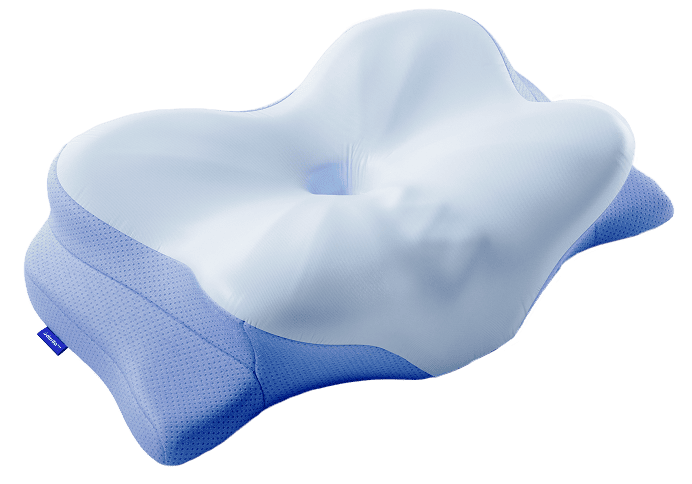
Derila Ergo contoured pillow
A molded memory foam contour pillow with two contour heights in one — flip it to change the height — made for side, back and stomach sleepers according to the manufacturer. Removable cover. Sizing and the two-week adjustment are in our full review.
- 60-night money-back guarantee, counted from delivery
- Up to 70% off currently
- Two contour heights: flip to adjust
- OEKO-TEX certified, per the manufacturer
Why does putting your arm over your head relieve the pain — and how do you use it safely?
This question splits the internet. Search “sleeping with arm over head” and you get a wall of articles saying never — all written about shoulder problems, where an arm left hanging overhead strains the joint. Then you notice you fall asleep faster with your hand behind your head, and wonder whether you're doing damage.
You're feeling something real. A nerve root that's irritated at the neck is also being pulled along its length by the weight of the arm hanging at your side — the arm is, quite literally, tension on the line. Lift the arm and rest it, and that tension eases, which is why many people notice their symptoms fade with the hand behind the head. We're describing the mechanism rather than quoting a trial, because we didn't find one with a number we'd stand behind.
So: the shoulder advice is about an arm left hanging with the joint bearing the load. The nerve relief comes from the arm being supported higher. You want the second without the first.
The safe version:
- Lie on your back, or on your good side.
- Put a second pillow beside your head, level with your main pillow.
- Rest the forearm of the sore side on it — hand near your head, elbow bent, the whole arm supported from elbow to wrist. Nothing hangs. Nothing is held up by muscle.
- If the shoulder itself starts to ache, lower the pillow an inch or two.
If this is the only position in which the arm stops hurting, tell your doctor — it's a useful clue.

What else gets you through the night?
- Heat before bed, not during. Fifteen to twenty minutes with a warm pack on the neck eases the muscles guarding the nerve. Don't fall asleep on a heating pad.
- Get out of bed without twisting. Roll onto your side, then push up with your arms. Sitting straight up from flat bends the neck under the weight of your head.
- Give any change two weeks. New pillow, new position, new arm setup — none feel normal on night one, and a contoured pillow takes about two weeks before it stops feeling strange. Judge on week two, not night two. That's why the return window matters: the Derila's 60-night money-back guarantee is counted from delivery, which covers the adjustment comfortably.
How long does a pinched nerve in the neck take to heal?
Here's the number that should reframe your next few weeks. Per StatPearls, over 85% of acute cervical radiculopathy resolves without any specific treatment within 8 to 12 weeks, and at three years 83% regain satisfactory function. The Rochester study, which followed its 561 patients for a median of 4.9 years, found 90% asymptomatic or only mildly limited at last follow-up; 26% had surgery at some point, a minority path even over that long window.
Two honest caveats. The 85% figure is for acute cases — a flare that started weeks ago, not years. And it can come back: recurrence was 31.7% in the Rochester series, which is the argument for keeping your sleep setup once the arm quiets down.
When to see a doctor
A pinched nerve is usually a wait-it-out problem. But StatPearls lists signs that need a clinician promptly rather than a better pillow: progressive weakness in the arm or hand (dropping things, a grip that's weaker week to week), new trouble with balance or walking, any change in bladder or bowel control, or severe, unrelenting pain that doesn't ease with treatment. Symptoms in both arms, or a neck problem with fever, night sweats or unexplained weight loss, also need a proper look. Nothing here is a diagnosis or a treatment plan.
The bottom line
Back first, good side second, stomach never — and on your side, pillow height decides whether the good side is actually good. Support the curve of your neck with a contoured pillow or a rolled towel, the setup the medical reference itself points to. If lifting your arm eases the tingling, put a pillow under it beside your head so the relief comes without the shoulder strain. Then give it two weeks, watch for the warning signs above, and remember that most acute cases settle within 8 to 12 weeks. You're not looking for a miracle pillow. You're looking for a lot of ordinary nights, one after another, until the arm goes quiet.
Frequently asked questions
What is the best sleeping position for a pinched nerve in the neck?
On your back, with a contoured pillow or a rolled towel supporting the curve of your neck and a pillow under your knees. Second choice: on the side that doesn't hurt, with a pillow tall enough to keep your head level. Avoid stomach sleeping. If lying flat sets off the arm, start the night semi-reclined at 30 to 45 degrees.
Why is my pinched nerve worse at night?
In bed you stop moving, your muscles let go, and the pillow decides the angle of your neck for an hour or more. If that angle bends the head toward the affected side, it narrows the opening the nerve root passes through. There's also nothing to distract you in a dark room, so the same tingling feels louder.
Should I sleep with or without a pillow if I have a pinched nerve?
With one, and specifically a cervical or contoured pillow. The StatPearls clinical reference on cervical radiculopathy (NIH) states that using a cervical pillow at nighttime can help alleviate symptoms and make sleeping easier during recovery, and that sleeping with a contoured pillow can relieve radicular discomfort. Tonight, a hand towel rolled into the edge of your pillowcase does the job.
Why does putting my arm over my head relieve the pain?
An irritated nerve root is also being pulled along its length by the weight of the arm hanging at your side. Raising and resting the arm takes that tension off. The shoulder-safe version is to rest the forearm of the sore side on a second pillow beside your head, elbow bent, so the arm is supported rather than hanging. If it's the only position that stops the pain, tell your doctor.
How long does a pinched nerve in the neck take to heal?
According to StatPearls, over 85% of acute cervical radiculopathy resolves without any specific treatment within 8 to 12 weeks, and 83% regain satisfactory function at three years. In the Rochester, Minnesota population study of 561 patients, 90% were asymptomatic or only mildly limited at last follow-up. Recurrence was 31.7%, a good reason to keep a supportive pillow setup afterward.
When is a pinched nerve an emergency?
See a clinician promptly for progressive weakness in the arm or hand, new trouble with balance or walking, any change in bladder or bowel control, or severe, unrelenting pain that doesn't ease with treatment. Symptoms in both arms, or neck pain with fever, night sweats or unexplained weight loss, also need to be checked. These are the warning signs listed in the StatPearls reference on cervical radiculopathy.
How we researched this article
A review of the published medical literature plus manufacturer specifications. Not laboratory testing, not medical advice. Derila Ergo details were checked against the manufacturer's information in September 2026; terms can change, so read them on the order page before you buy.
Sources cited in the text:
- Margetis K, et al. Cervical Radiculopathy. StatPearls (NIH), updated August 2025 — NCBI Bookshelf
- Radhakrishnan K, et al. Epidemiology of cervical radiculopathy: Rochester, Minnesota, 1976–1990. Brain, 1994 — PubMed
- Carmichael J, et al. Scapular pain in cervical radiculopathy: a scoping review. N Am Spine Soc J, 2025 — PMC
Read next
- How to sleep with neck pain — the rolled towel, step by step
- Pillow height for side sleepers — measure, then buy
- Cervical pillow for neck pain — the complete guide
- Our full Derila Ergo review — rating, sizing, the two-week adjustment