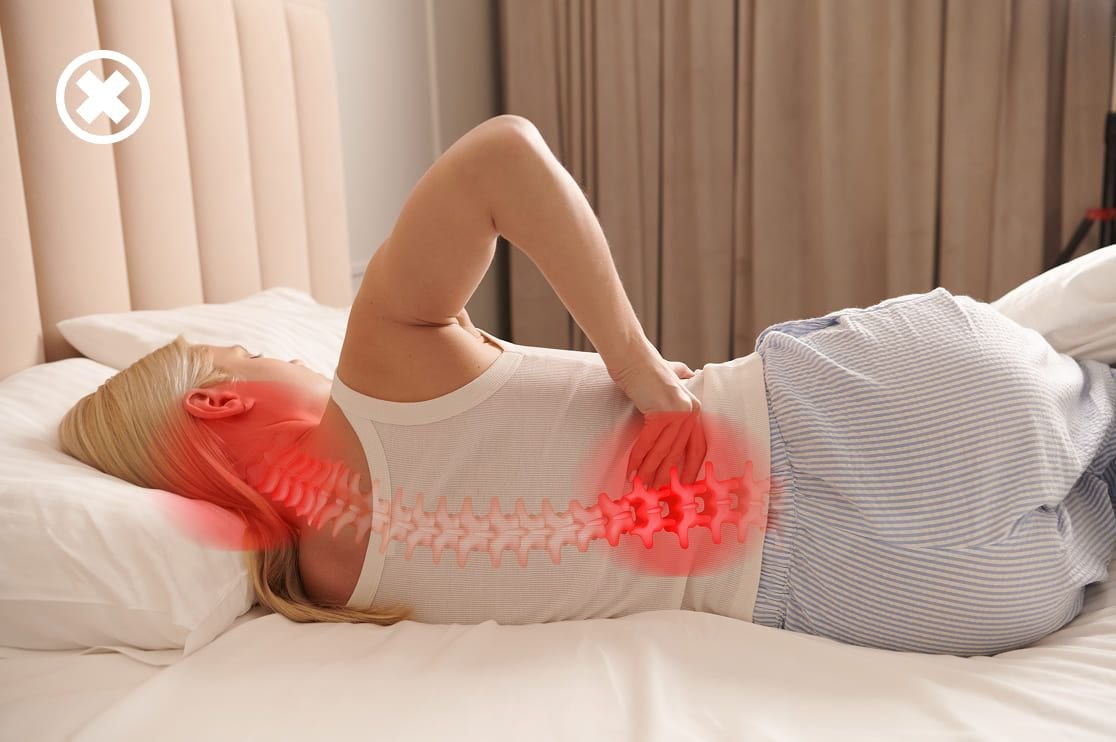
You most often wake up with a stiff neck because your pillow is the wrong height, so your head sits out of line with your spine for hours. Position, a flattened pillow, cold air, desk posture and stress explain most of the rest. It usually eases in 24 to 72 hours with gentle movement.
How long does a stiff neck from sleeping last?
Straight answer: most people notice clear improvement within 24 to 72 hours, and simple sleep-related stiffness has usually resolved within a week. It follows a predictable curve — worst in the first hour of the day, better with movement, better again the next morning.
Three timings are worth knowing.
- Better within a day or two: ordinary muscular stiffness from a bad night. Nothing to do but the relief steps below and a look at your pillow height.
- Still there after a week or two: worth a call. NHS guidance is to see a GP if neck pain or stiffness does not go away after a few weeks, or if painkillers are not helping.
- Back every few weeks: the individual episode is not the problem; the setup is. Something you do every night is causing it, and that is where a pillow, a mattress or a sleeping position comes into it.
What to do today, in the first hour
Before the causes, the relief. The self-care steps below follow NHS guidance on neck pain and a stiff neck, which is free to read and more specific than most of what circulates online.
- Cold pack or heat, whichever helps. The NHS suggests a cold pack — a bag of frozen peas wrapped in a tea towel — for about 5 minutes, three times a day, or a hot water bottle wrapped in a tea towel for around 20 minutes, two to three times a day. Wrapped, never straight onto skin. Either is fine; use the one that gives you more relief.
- Keep the neck moving. This is the part people get wrong. The NHS advice is explicit: do not wear a neck collar, because it is better to keep your neck moving. Gentle range of motion — slowly turning your head left and right, ear toward shoulder, chin toward chest, within the limit of comfort — beats a day on the sofa holding your head still.
- Do not force the stretch. Slow, small, repeated. If a movement produces sharp pain, that is the edge; stop before it.
- Painkillers if you need them. Paracetamol or ibuprofen, or ibuprofen gel on the neck, are the over-the-counter options the NHS lists. Follow the packet.
- Use a low, firm pillow tonight. Also straight from the NHS list, and it lines up with everything below about height. If you woke up stiff on the same side twice this week, sleeping the same way tonight will produce the same morning.
A stiff neck that is easing a little each day is behaving normally. The NHS advises seeing a GP if neck pain or stiffness does not go away after a few weeks, if painkillers are not helping, or if you have other symptoms such as pins and needles or a cold arm.
Morning neck stiffness has a particular signature. It is at its worst in the first ten minutes of the day, it loosens as you move around, and by mid-morning you have half forgotten about it.
That pattern is a clue. Pain that is worst on waking and improves with movement usually points at the seven hours you just spent lying still — not at anything you did the day before.
1. Your pillow is the wrong height
This is the most common cause, and the least examined. Almost nobody chooses a pillow by height. People choose by feel in a shop, or by price online.
Height is the thing that decides whether your neck spends the night straight or bent. Too low and your head drops. Too high and your chin is pushed toward your chest. Either way, muscles that should be resting hold tension instead.
How much height you need depends on your sleeping position and how broad your shoulders are. Side sleepers need the most, because they are filling the whole gap between ear and shoulder. Back sleepers need much less, but they need it under the neck rather than under the head.
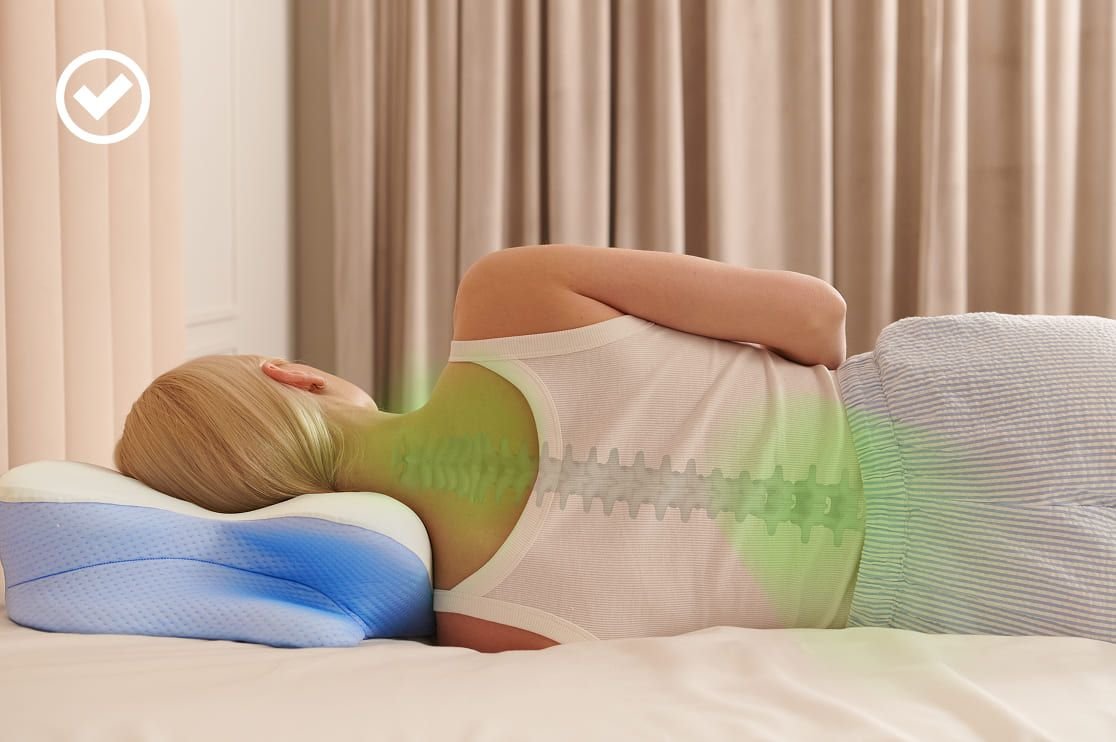
If you want the height numbers by position, we broke them into a table in our guide to cervical pillows for neck pain.
2. Your pillow has quietly died
Pillows do not fail dramatically. They sag by a millimetre a month, and because it happens slowly, you adjust to it without noticing.
The common recommendation, including in the Sleep Foundation's guide to replacing pillows, is every one to two years for most types. Three quick tests matter more than the calendar:
- The fold test. Take the pillowcase off, fold the pillow in half, and let go. A pillow with life in it springs back open on its own. A dead one stays folded, or opens slowly and only halfway. That is a pillow that has stopped holding your head up, and it will not recover.
- Notice whether you double it over during the night to get more height. Your body is telling you the number it wants.
- Notice whether you have to punch it into shape before you can settle.
If any of those sound familiar, you have been sleeping on a flat surface with a pillowcase on it — the full list of signs, including the right tests for memory foam, is in how often to replace your pillow.
"Should I just sleep without a pillow?"
Short and honest: only if you sleep on your stomach. Face-down, a pillow tilts your head back and adds a second problem to the rotation you already have, so thin or none is genuinely better.
For anyone else it makes things worse. On your back you need a modest amount of support under the hollow of your neck; without it your head tips back and your jaw drops open. On your side you need to fill the whole width of your shoulder, and no pillow means your head hangs toward the mattress for hours. Going pillowless is not a neutral experiment for a side sleeper — it is choosing the most extreme wrong height available.
3. You sleep on your stomach
Face-down sleeping turns your head roughly 90 degrees and holds it there for hours. No pillow fixes that rotation, because the rotation is the position.
If you are a committed stomach sleeper with morning neck stiffness, the honest advice is unglamorous: use the thinnest pillow you can tolerate, or none, and work on shifting to your side. A body pillow to hug helps, because it gives your arms somewhere to go.
4. Your mattress is dragging your pillow down
People blame the pillow and pardon the mattress. If your mattress sags in the middle, your shoulders and hips sink lower than they should, and suddenly a pillow that was the right height is too low.
The test: lie on your side and have someone photograph you from behind. If your spine curves like a hammock instead of running straight, the mattress is part of the problem.
5. You slept hot and moved all night
Overheating does not cause neck pain directly. It causes movement, and movement is what leaves you in bad positions.
Your body needs its core temperature to drop by roughly one to two degrees Fahrenheit to fall and stay asleep. Solid memory foam and thick synthetic filling trap heat under your head, which works against that. You surface, you flip the pillow, you settle in a worse position, and you repeat this six times without ever fully waking up.

6. Cold air on an uncovered neck
A draught from an air conditioner, a fan pointed at the bed, or an open window in winter can leave neck muscles tight and guarded by morning. It is a small effect, but it is real, and it is the easiest one on this list to test: move the fan, close the window, see what happens over three nights.
7. Your day, not your night
Eight hours at a laptop with your head tilted forward loads the same muscles that ache in the morning. Stress does something similar — people hold tension in the neck and shoulders without noticing, and a night of shallow sleep does not release it.
The tell here is timing. If your neck also hurts in the evening, or gets worse as the day goes on, your pillow is not the main character. Your desk is.
The 30-second self-check
Ask yourself one question: when is it worst?
Worst on waking, better by lunch → your sleep setup. Height, pillow age, position, temperature.
Worst in the evening, builds through the day → posture, desk, stress.
Bad all the time, or getting worse → see a healthcare professional.
The two that are not a pillow problem
Stop shopping and see a professional if
- Numbness, tingling or weakness runs into your arm or hand. That suggests nerve involvement, and it needs to be looked at properly.
- You snore loudly every night, gasp awake, or stop breathing during sleep. A 2025 analysis in Respiratory Medicine put obstructive sleep apnea at 83.7 million US adults — 32.4% of the adult population — and largely undiagnosed (Respiratory Medicine, 2025). The Wisconsin Sleep Cohort estimated that 93% of women and 82% of men with moderate to severe apnea had never been clinically diagnosed (Young et al., Sleep, 1997). Morning headaches and neck tension often travel with it.
Also worth a call: neck pain after any impact or fall, pain with unexplained weight loss, or severe pain that no position relieves. Better Nights is an editorial site — nothing here is a diagnosis.
One stiff neck that is an emergency: meningitis
Rare, and worth naming plainly rather than hiding behind "see a doctor if concerned". A stiff neck caused by sleeping is annoying and moves. A stiff neck caused by meningitis comes with other things, and it moves fast.
Get emergency help if neck stiffness comes with any of these: fever, confusion or unusual drowsiness, severe headache, nausea or vomiting, sensitivity to light, or a rash of small dark spots that does not fade when you press a glass against it. Difficulty touching your chin to your chest because the neck simply will not bend is another classic sign.
This is not a wait-and-see situation. It is an emergency room, the same day.
A small one nobody mentions: hydration
The discs between your cervical vertebrae are largely water. They lose height across the day under load and rehydrate overnight while you are lying down, which is why people are measurably taller in the morning. Being persistently under-hydrated does not cause a stiff neck by itself, but dehydrated tissue is stiffer and slower to recover, and a night of alcohol — which is both a diuretic and a muscle relaxant that wrecks position — is a reliable recipe for a bad morning.
Nobody needs a water-tracking app for this. Drink normally through the day, take it easier on the alcohol on nights when your neck is already sore, and treat it as a supporting factor rather than a cause.
So what do you actually change first?
Work cheapest to most expensive. Move the fan. Give your pillow the fold test. Then look at height, because that is where most people are quietly wrong.
A contoured pillow is aimed at exactly that: a lower center where your head sits, a raised edge that fills the space under your neck, and enough firmness that it still does both at 4am.
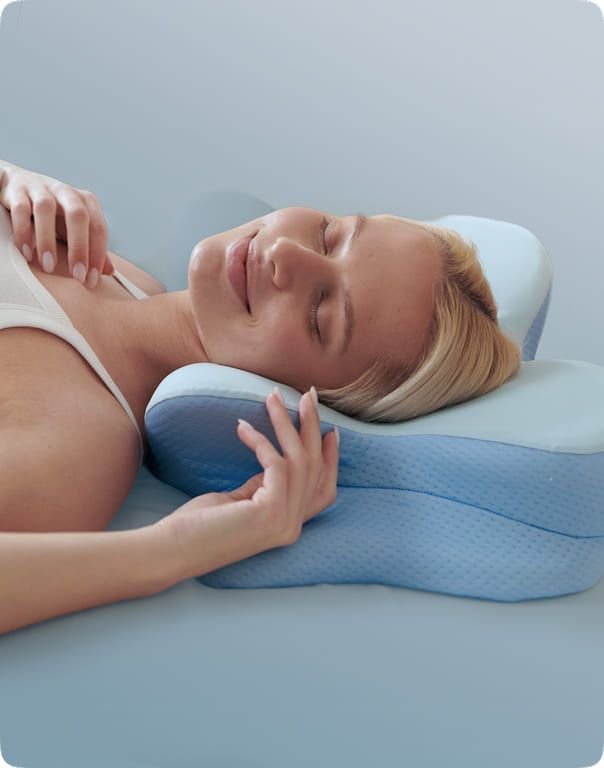
Derila Ergo contoured pillow
Molded memory foam with a dipped center and raised wings, so the height is different depending on whether you land on your side or your back. Ventilated foam, washable cover.
- 60 nights to return it
- Up to 70% off currently
- 3 free bonuses
What the 60-night guarantee actually involves
Worth reading before you order. On the manufacturer's own support pages, the 60 nights are counted from the day the parcel is delivered, not from the day you order — so shipping time does not come out of your trial, which is more generous than it sounds. Returns need an RMA number, requested by email at support@derila.com, before you send anything back. Return postage is at your cost. The refund is issued within 14 days of the warehouse receiving the pillow, and usually reaches your account 3 to 5 business days later. Terms can change, so check them on the order page.
Before you buy anything, get the height right
Everything above narrows the problem down. This is the part that solves it, and it is a measurement rather than a purchase.
Lie on your side with no pillow and have someone measure straight up from the mattress to the side of your neck, just below your ear. That gap is the height your pillow has to hold. Research from 2024 that derived optimal pillow height from shoulder width found 9.7–11.8 cm gave the best neck alignment and 11.8–13.8 cm scored highest for comfort, and a firm mattress needs more height than a soft one because your shoulder sinks in less.
We walk through the measurement, the heights for back and stomach sleeping, what the research does and does not support, and how to tell adjustment ache from a genuinely wrong height, in the full guide: cervical pillow for neck pain — what actually works. If you sleep mainly on your side, start with pillow height for side sleepers instead.
Who should not buy a new pillow
Not everyone reading this needs to spend money, and we would rather say so.
- Your neck also hurts in the evening. Pain that builds through the day belongs to your desk, not your bed.
- You have numbness, tingling or weakness in an arm. See someone first.
- This is a one-off after an unusual night. One bad night on a sofa is not a pillow problem. Wait a week.
- Your mattress sags. Your shoulder is dropping into a hollow, which makes any correctly sized pillow too low. Fix that first or the new pillow arrives at the wrong height.
- You measured and you are already within a centimetre or two. A different brand at the same height changes nothing.
Whatever you try, give it two full weeks before you judge it. A new pillow height feels wrong for the first few nights precisely because it is different from what your muscles have adapted to.
How we researched this article
A review of the published literature plus a practical self-check guide, alongside manufacturer specifications and publicly available customer feedback. Not laboratory testing, and not medical advice. Return and refund terms come from the manufacturer's own support pages, checked in August 2026.
Sources cited in the text:
- Self-care for neck pain and stiff neck — NHS
- Obstructive sleep apnea prevalence in US adults, 2024 — Sönmez I et al., Respiratory Medicine, 2025
- Undiagnosed proportion in men and women — Young T et al., Sleep, 1997 (Wisconsin Sleep Cohort)
- Optimal pillow height derived from shoulder width, 2024 — PubMed
- Individually adjusted pillow height and chronic neck pain — Journal of Physical Therapy Science, 2023
- Overall strength of evidence for pillows and neck pain — systematic review, NCBI Bookshelf
- Pillow replacement intervals — Sleep Foundation
Frequently asked questions
Why do I wake up with a stiff neck but feel fine during the day?
That pattern points at your sleep setup rather than an injury. The most likely causes are a pillow of the wrong height, a pillow that has gone flat, or a sleeping position that holds your neck at an angle for hours. Muscles held in a stretched or compressed position stiffen up and then release once you start moving.
How long does a stiff neck from sleeping last?
Most people improve clearly within 24 to 72 hours, and simple sleep-related stiffness has usually gone within a week. If it is no better after a week, or it comes back every few weeks, the individual episode is not the problem — something in your sleep setup is causing it, and it is worth getting checked.
How do I get rid of a stiff neck fast?
NHS guidance is a wrapped cold pack for about 5 minutes three times a day, or a wrapped hot water bottle for around 20 minutes two to three times a day — whichever helps more — plus paracetamol or ibuprofen if you need it, and a low, firm pillow. Keep the neck moving rather than resting it completely, and do not use a neck collar. Most simple morning stiffness settles within a day or two. See a GP if it does not go away after a few weeks, if painkillers are not working, or if you have pins and needles or a cold arm.
When is a stiff neck an emergency?
When it comes with fever, confusion or drowsiness, severe headache, nausea or vomiting, sensitivity to light, or a rash of small dark spots that does not fade under pressure — that combination can mean meningitis and needs emergency care the same day, not a wait-and-see. A neck that will not bend enough to touch chin to chest is another classic sign. Neck pain after a fall or crash also needs immediate assessment.
Is it my pillow or my mattress?
Both matter, and they interact. A sagging mattress lets your shoulders drop, which makes a correctly sized pillow suddenly too low. Test the pillow first because it is far cheaper to replace, and look at the mattress if your hips also ache.
Should I sleep without a pillow to fix neck pain?
Only if you sleep on your stomach. Back sleepers need modest support under the neck, and side sleepers need substantial height to keep the head from dropping. Going without a pillow as a side sleeper usually makes stiffness worse, not better.
How long should it take a new pillow to help?
Give it two weeks. The first few nights on a different height feel unfamiliar even when the support is right, because your muscles have adapted to the old angle. Judge it at day 14.
Read next
- Cervical pillow for neck pain: the complete guide — heights by position, in a table
- Pillow height for side sleepers with neck pain
- Can a pillow stop snoring?
- Our full Derila Ergo review